Offshore software development rates are often the first thing to look at when planning a new product. The numbers vary widely, and without context, it is easy to underestimate the real cost or overpay for the wrong setup.
Rates alone do not tell the full story. Team structure, seniority level, location, cooperation model, and even compliance requirements all shape the final budget. Two vendors may quote similar hourly rates, yet the total cost and delivery speed can differ significantly.
In this article, we break down what actually influences offshore software development rates, review realistic ranges by country, and explain how to approach cost estimation in a way that protects your budget and supports long term product growth.
How Offshore Software Development Rates Impact Profitability
A startup or growth-stage business budget is a clear outline of how you plan to use your funds to cover product and operational costs. This is applicable to pre-revenue tech companies as well as small and medium-sized companies that scale an existing product or launch a new digital initiative
Your budget defines how long you can operate before the next funding round, revenue milestone, or expansion phase. The more realistic your cost assumptions are, the more stable your planning becomes.
In case you plan to outsource part of product development, offshore rates for software development will go to that expense line in your budget. And the numbers you put in that line can differ a lot depending on location, team structure, and cooperation model.
When you're familiar with the offshore software development rates by country, software developer contractor rates, freelance software developer rates, and average offshore software development rates, it presents an opportunity for cost savings and business investment. You gain the ability to compare options, evaluate trade-offs, and allocate resources where they bring the highest return. This helps startups protect their runway and helps small and medium-sized businesses control margins during growth.
For example, if engineering salaries are your most significant expense, hiring a dedicated team with a lower average hourly rate for software developers can help you cut expenses on development.
In practical terms, knowledge of offshore software development rates allows you to choose a partner based on long-term value, not just the lowest quote.

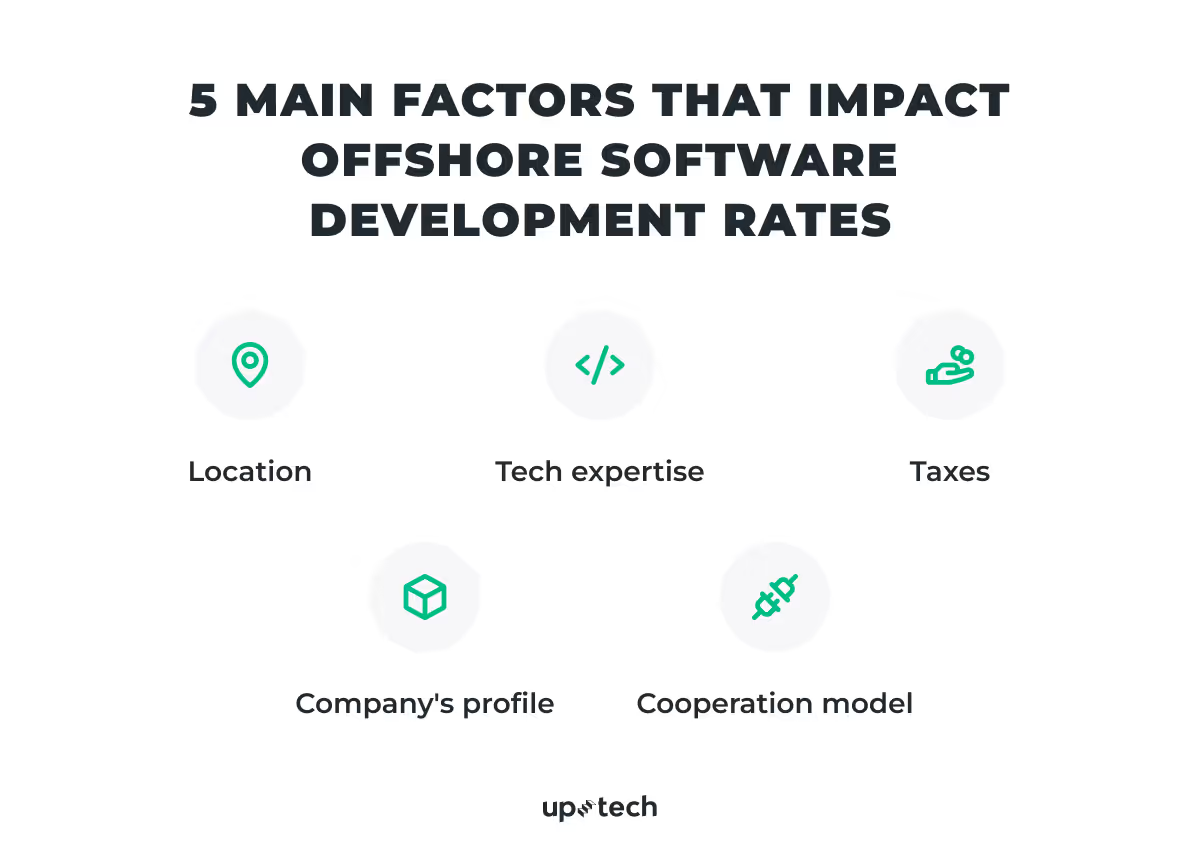
5 Key Factors That Impact Offshore Software Development Rates
If you have researched offshore software development rates, you have likely seen how widely they vary. This difference is not random. The thing is, there are a number of factors that make up the final check. Below, I’ll explore the factors that contribute to the offshore rates for software development.
Location
The main factor that affects offshore software development rates is location. Different countries have different rates for software development services. For example, Ukrainian developers’ hourly rates are lower than in the US or Canada. Other countries that are known for offering competitive rates include China, the Philippines, India, Poland, Argentina, and Brazil.
However, location influences more than just hourly rates. It reflects the overall cost of living, salary expectations, tax structure, and local competition for tech talent. In mature tech ecosystems, companies compete aggressively for senior engineers, which pushes compensation higher. In emerging markets, the cost structure is different, which often results in more affordable rates.
Location also affects talent availability and specialization. Some regions have strong expertise in fintech, generative AI, or enterprise systems, while others focus more on outsourcing execution. The depth of the senior talent pool, English proficiency, and experience with international clients also shape both pricing and delivery quality
The rates can also vary within a country depending on the location of the development team. For instance, the rates for software development in a major city may be higher than in a smaller city or town.
Company’s profile
Another factor that can influence offshore software development rates is the company’s profile. What do I mean by saying “company’s profile”? Well, it’s all about the company’s portfolio, previous clients, projects, and their rating on platforms like Clutch. Companies with proven experience in complex projects or regulated industries often charge higher rates because they bring established processes, senior expertise, and predictable delivery standards.
A strong portfolio usually signals more than technical capability. It reflects the ability to manage scope, handle product evolution, maintain code quality, and support scaling. Vendors that have worked with well-known brands or fast-growing startups tend to price their services accordingly, as clients are paying not only for development hours but also for accumulated experience and risk reduction.
You can check our cases and get to know how we helped to develop such awesome products as Dollar Shave Club, GOAT, Aspiration, Cardless, MicrogenDX, Presidio Investors, and more. Also, we have awesome projects on Dribbble and Behance to check out.
Also, when you evaluate a company profile, it is important to look beyond brand names. Consider project complexity, long-term collaboration history, client retention, and technical depth. These factors often explain differences in offshore software development rates more accurately than hourly numbers alone.
Tech expertise
The programming languages and tech stack used in software development can also affect the offshore rates for software development. Developers with expertise in the latest technologies or niche programming languages may have higher hourly rates than developers with more general skills.
This difference is usually linked to seniority level and market demand. Engineers who work with modern cloud infrastructure, AI systems, high-load architectures, or complex integrations often bring deeper architectural experience. That level of responsibility is reflected in pricing.
Moreover, some technologies or platforms may require specialized knowledge and experience, which can also increase the rates. For example, developing a fintech solution may require additional expertise in security practices and may come at a higher cost.
The same applies to healthcare products that require regulatory compliance, or AI-driven platforms that depend on data engineering and model integration. In these cases, companies are not only paying for coding skills but for domain knowledge, risk mitigation, and long-term scalability decisions.
It is also worth noting that higher technical expertise can reduce total project cost over time. Senior engineers may have higher hourly rates, but they are less likely to introduce architectural mistakes or technical debt that leads to expensive rework later.
Taxes
Taxes can also impact offshore software development rates. For example, in some countries, software development services are subject to value-added tax (VAT), which can increase the overall cost.
Here's a breakdown of how VAT and other taxes impact offshore software development rates in top offshore destinations:
- In Ukraine, the standard rate of VAT is 20%. However, IT services and software development have been exempt from VAT since 2013, with the exemption currently in place through at least January 2028. On top of that, IT service exports to foreign clients are zero-rated, so there are no hidden consumption taxes for offshore buyers.
Ukraine also has a dedicated legal and tax regime for IT companies that makes it one of the most attractive offshore development destinations in Europe.
- In India, the GST rate for software development services is 18%. For foreign clients, though, this rate is largely a non-issue since services exported to clients outside India are zero-rated. One thing to keep in mind, though, India distinguishes between custom software development and off-the-shelf packaged software, which are taxed differently. So make sure to clarify with your vendor how they plan to classify the work.
- In Poland, the standard VAT rate is 23%, and this applies to most IT services, including software development and consulting. However, if you're outsourcing from abroad, you generally won't be charged VAT. Polish suppliers don't apply VAT on services exported outside the EU, and EU-based clients benefit from the reverse charge mechanism. Poland also offers a compelling IP Box regime, which taxes income from software-related intellectual property at just 5% corporate income tax, making it an attractive destination for development partners.
- In the Philippines, the standard VAT rate is 12%. However, software development services delivered to foreign clients are generally zero-rated, meaning you won't be charged VAT as an offshore buyer. The country also introduced a VAT on Digital Services in 2025, targeting foreign providers selling digital services into the Philippine market
- In China, the standard VAT rate for software development services is 6% for domestic transactions. However, when services are provided to foreign clients (offshore outsourcing), the transaction is generally zero-rated for VAT under China's export of services rules. China enacted a new VAT Law effective January 1, 2026, which retains this structure. Foreign companies should still be aware of additional complexities, including withholding taxes, foreign exchange controls, and evolving cross-border transaction rules, which can make China a more challenging destination for offshore software development.
Cooperation model
The cooperation model you choose for your offshore software development project can also affect the cost. The most common cooperation models are time and material, fixed price, and dedicated team.
- Time and material: In this model, you pay for the actual hours worked and the resources used. This model is suitable for projects with a flexible scope, where changes can occur during the development process. However, it can be difficult to estimate the final cost, as the scope may change.
- Fixed price: In this model, you agree on a fixed price for the entire project. This model is suitable for projects with a well-defined scope, as you can accurately estimate the cost upfront. However, changes to the scope can result in additional costs.
- Dedicated team: In this model, you hire a dedicated team of offshore software developers to work on your project. This model is suitable for long-term projects and can provide better cost control and more flexibility. However, it requires more management and communication effort from your side.
Offshore Software Development Rates by Country
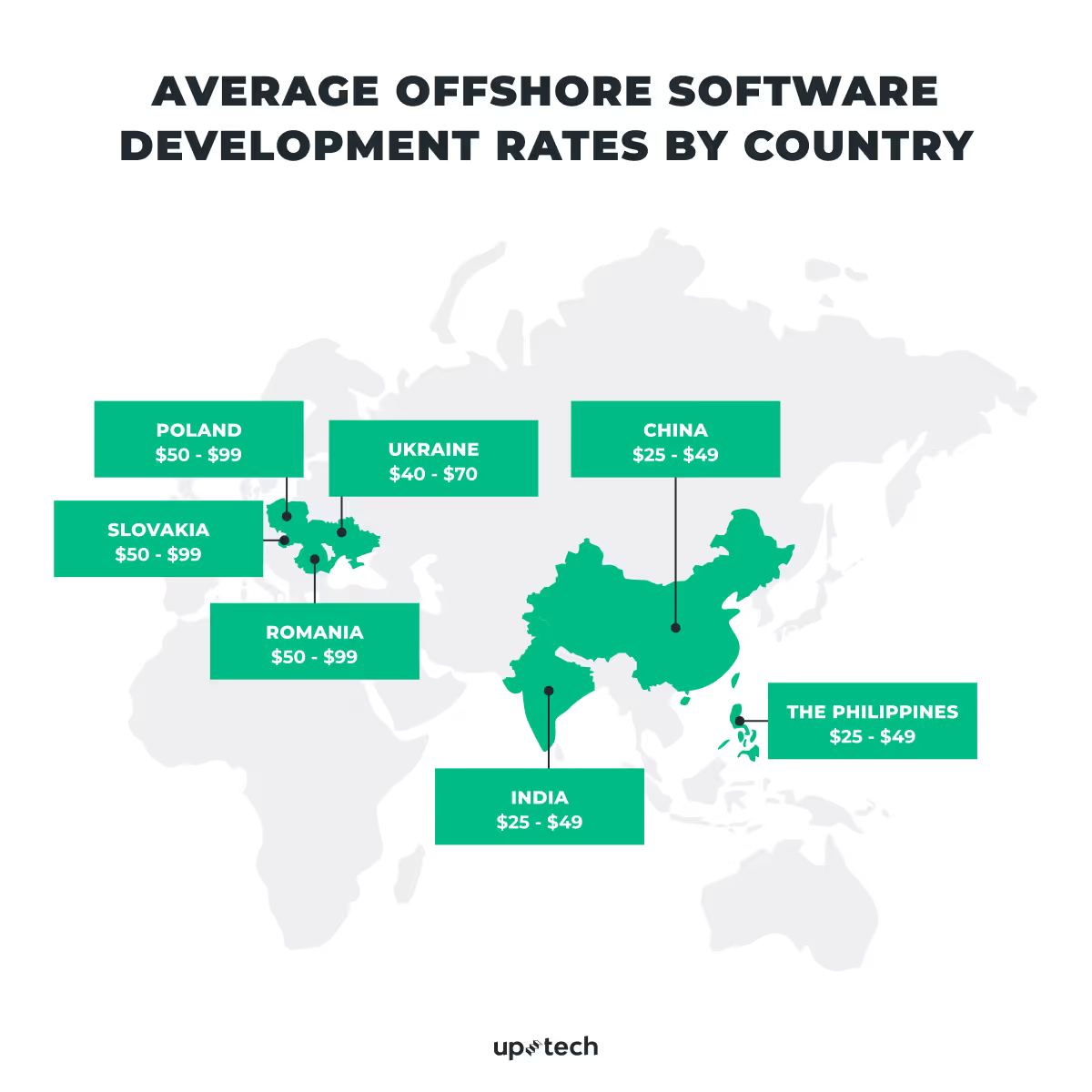
When it comes to offshore software development, the location you choose can make a significant difference in the cost of your project. Here's a sneak peek at the average offshore software development rates in several popular countries.
The pricing ranges below are rough market estimates based on mid- to top-tier companies listed on Clutch and similar industry platforms. They should be treated as directional benchmarks rather than fixed standards, since final rates depend on seniority level, project complexity, and cooperation model.
Average Offshore Software Development Rates by Country
- Ukraine: $40-$70
- India: $25-$49
- Poland: $50-$99
- Romania: $50-$99
- Slovakia: $50-$99
- The Philippines: $25-$49
- China: $25-$49
Offshore software development rates in Ukraine
Ukraine is an increasingly popular destination for offshore software development due to its large pool of highly skilled IT professionals. The average hourly rate for software development in Ukraine is around $40-$70, depending on the project's complexity and technology stack, as well as the seniority of the hired software engineers.
Ukraine has built a strong engineering culture over the past two decades, with a focus on mathematics, computer science, and technical education. Many developers have experience working with US and EU clients, which means familiarity with international product standards, Agile processes, and business communication expectations.
Another advantage is the depth of the senior talent pool. Ukrainian teams are often involved not only in execution but also in product discovery, architecture decisions, and long-term scaling strategies. This makes the market attractive for startups as well as for small and medium-sized businesses that need strategic input, not just development capacity.
English proficiency, time zone overlap with Europe, and reasonable overlap with US working hours also support smoother collaboration compared to more distant offshore regions.
Despite recent geopolitical challenges, the Ukrainian IT sector has demonstrated strong operational resilience, with distributed teams, backup infrastructure, and continuity planning that allow projects to run without interruption.
Offshore software development rates in India
India has long been a top destination for offshore software development due to its vast talent pool and cost-effectiveness. The average hourly rate for software development in India is around $25-$49, depending on the project's complexity and technology stack.
India’s main strength lies in scale. The country produces a large number of engineering graduates every year and offers one of the biggest IT labor markets globally. This creates wide pricing flexibility, from budget-friendly vendors to premium engineering firms.
At the same time, the market is highly diverse. Quality, seniority level, and communication standards can vary significantly between providers. For that reason, vendor selection and technical evaluation become especially important.
India is often a strong fit for large-scale projects that require rapid team expansion or cost-sensitive execution. However, time zone differences with Europe and the US may require additional coordination effort.
Offshore software development rates in Poland
Poland has gained a reputation as a quality offshore software development destination in recent years. The average hourly rate for software development in Poland is around $50-$99, depending on the project's complexity and technology stack.
As a European Union member, Poland offers strong regulatory alignment with EU standards, including GDPR compliance and structured data protection practices. This makes it particularly attractive for companies operating within the European market.
Poland’s tech ecosystem is mature, with a solid base of senior engineers and experience in enterprise systems, fintech, and SaaS platforms. The market, however, is more competitive and closer in pricing to Western Europe compared to other Central and Eastern European countries.
For businesses that prioritize regulatory stability, EU jurisdiction, and cultural proximity to Western Europe, Poland is often seen as a lower-risk but higher-cost offshore option.
Offshore software development rates in Romania
Romania is an emerging destination for offshore software development, known for its highly skilled IT workforce. The average hourly rate for software development in Romania is around $50-$99, depending on the project's complexity and technology stack.
Romania benefits from strong technical education and a growing presence of international tech companies. As a member of the European Union, it operates under EU regulations, which can simplify legal and compliance processes for European clients.
The Romanian market is often positioned between cost efficiency and EU-level stability. While rates are generally higher than in some other Central and Eastern European countries, companies gain regulatory alignment and cultural proximity to Western Europe.
Romania is frequently chosen by businesses that seek a balance between technical capability, EU jurisdiction, and moderate pricing compared to Western European markets.
Offshore software development rates in Slovakia
Slovakia is a small but growing destination for offshore software development, thanks to its highly skilled and cost-effective IT workforce. The average hourly rate for software development in Slovakia is around $50-$99, depending on the project's complexity and technology stack.
As a member of the European Union and the Eurozone, Slovakia offers regulatory stability and alignment with EU legal standards. This can simplify contracting and compliance for companies operating within Europe.
The Slovak tech market is smaller compared to Poland or Romania, which means the available talent pool is more limited. However, teams often have strong technical backgrounds and experience working with European clients.
Slovakia is typically considered by businesses that prioritize EU jurisdiction and stability, while still aiming to keep development costs below Western European levels.
Offshore software development rates in the Philippines
The Philippines is becoming an increasingly popular destination for offshore software development due to its cost-effective and highly skilled IT workforce. The average hourly rate for software development in the Philippines is around $25-$49, depending on the project's complexity and technology stack.
One of the Philippines’ strongest advantages is English proficiency and cultural alignment with Western markets. Communication tends to be smooth, which reduces friction in daily collaboration.
The country has traditionally been strong in business process outsourcing, and its IT sector continues to expand. While the senior engineering pool is smaller compared to larger markets such as India, many teams offer competitive pricing for small to mid-sized projects.
The Philippines is often selected for cost-sensitive initiatives where communication clarity and flexibility are priorities, especially for US-based companies.
Offshore software development rates in China
China has a vast and rapidly growing IT industry, making it an attractive destination for offshore software development. The average hourly rate for software development in China is around $25-$49, depending on the project's complexity and technology stack.
China’s tech market is large and fast-moving. Many engineers gain hands-on experience as they work on high-scale consumer platforms, e-commerce systems, and mobile products. This exposure helps teams build strong execution skills, especially in technically demanding environments.
At the same time, companies from the US or Europe often pay close attention to legal structure, data protection rules, and communication setup before starting cooperation. Contracting and regulatory processes can require more preparation compared to EU-based countries.
China is usually considered when scale and technical capacity are priorities, but businesses tend to weigh operational and legal factors carefully before making a final decision.

How to Estimate Offshore Software Development Cost for Your Project
When things go south, most startups fail because they lack the money to deal with unexpected problems.
You should calculate the expenses as accurately as possible. Hiring a good financier can be helpful. But before hiring an offshore software development partner, you can take a few steps to estimate the offshore software development costs for your startup project.
Below, I gathered some handy tips to help you. Check out what you can do to get a better picture of the final offshore software development rates.
Define your project scope
Before you can estimate offshore software development costs, you need to define your project scope. Start by identifying the features and functionalities you want to include in your product. Once you have a clear idea of what you want to build, you can work with your offshore software development team to estimate the cost and timeline of your project.
Consider your development partner's experience
When choosing an offshore software development partner, consider their experience and expertise. A partner with more years of experience in your industry and relevant cases will understand your business needs and is more likely to provide a better solution, but get ready that the average hourly rate for a software developer in this offshoring company can be higher. You get what you pay for.
Look beyond hourly rates
Hourly rates are an important factor when estimating offshore software development costs, but they're not the only factor. A lower hourly rate may seem appealing, but if it takes longer to complete the project or the quality of the work is lower, you may end up paying more in the long run. Consider factors like the team's experience, the quality of their work, and their communication skills when choosing an offshore software development partner.
Use Agile development
Agile development is a project management methodology that can help you estimate offshore software development costs more accurately. With Agile development, you break your project down into smaller, more manageable tasks and work on them in short sprints. This allows you to adjust your project scope and budget as you go based on your progress and feedback from your customers.
We at Uptech have practiced Agile development since 2016. And we believe that it’s the best option for startups because it leaves space for maneuvering and lets us build product development in the most time and cost-effective way.
Consider the cost of communication
Communication is a critical factor in offshore software development projects. Make sure that you have a plan for communicating with your offshore software development team, and factor in the cost of communication when estimating your project budget. Consider using video conferencing tools, instant messaging, and project management software to help you stay in touch with your team.
Decide on the cooperation model
I mentioned above that the cooperation model you choose for your offshore software development project also affects the cost. Depending on what model you choose: time and material, fixed price, or dedicated team, the price will differ. Note that not all outsourcing companies offer all three, so you should keep an eye on that too.
How to Reduce the Offshore Software Development Cost
When a client asks me what we adopt to reduce the offshore software development cost, I always provide a few lifehacks: choose a dedicated team cooperation model, prioritize features, and invest in a proper discovery phase.
However, cost reduction does not mean that you just choose the cheapest hourly rate. It means that you structure the project in a way that prevents waste, delays, and unnecessary rework.
Hire a dedicated offshore team
Hiring a dedicated offshore team can be more cost-effective than hiring individual developers. When you work with a dedicated offshore team, you have access to a group of developers with a range of skills and expertise, as well as a project manager who oversees the work and ensures that it is completed on time and within budget.
This model reduces onboarding time, communication gaps, and coordination overhead. Instead of managing separate contractors, you work with a cohesive unit that already has internal processes and shared responsibility.
Moreover, when you work with a dedicated offshore team, you have the option to scale the team up or down based on your project requirements. This means you can bring in additional resources as needed without incurring additional overhead costs.
In practice, this flexibility protects your budget during product discovery and early scaling stages, when priorities often shift.

We used a dedicated team model while working with our client Nomad, a personalized house-hunting platform for the Middle East. With all the flexibility that this model gives, we could take an idea from concept to development.
Plus, a dedicated model is all about teamwork and experience sharing. And the words of Nomad’s co-founder & CPO, Daniel Piehler describes it better than anything:
“They were always ready to teach me new methods and were willing to try new approaches, workshops, and exercises. I was definitely impressed by the intellectual rigor that goes behind their mindset and organization of the workflow.”
Prioritize features
Prioritizing features helps you focus on what is most important for your product, avoid scope creep, and reduce the risk of going over budget. It also allows you to get your product to market faster, which can help you start generating revenue and attracting customers sooner.

Clear prioritization forces difficult but necessary decisions. Instead of building everything at once, you validate assumptions step by step. This reduces unnecessary development hours and prevents investment in features that users may not need.
A mental health marketplace for online therapy called Clearly is a strong example of this approach. This is our internal R&D project. The product started as a lean MVP with a landing page, therapist listings, and messenger-based communication. The goal was not to build a full-scale healthcare platform from day one, but to validate demand and core assumptions first.
Only after confirming product-market fit did the team expand the system into a web and mobile platform with secure video sessions, analytics, AI-powered features, and full GDPR and HIPAA compliance support.
This phased approach helped us control development costs at each stage. Instead of investing heavily upfront, the team allocated budget based on validated traction and measurable growth.
Today, Clearly supports over 30,000 therapy sessions per month across web, iOS, and Android.
The disciplined feature prioritization and staged architecture decisions allowed the platform to scale without unnecessary rework or budget spikes.
Invest in a structured discovery phase
Many budget overruns start long before development begins. They start with unclear assumptions, undefined success metrics, and vague scope boundaries.
A structured project discovery phase aligns business goals, user journeys, technical constraints, compliance requirements, and delivery milestones before engineering hours accumulate. It answers critical questions: What problem are we solving first? What is the measurable outcome? What can wait?
Discovery also helps define realistic team composition, architecture decisions, and infrastructure needs. Without this clarity, teams often build features that later require redesign, refactoring, or technical rework.
At Uptech, we never skip the discovery stage. It is a mandatory step before full-scale development because it protects both the product and the budget. We also offer software product discovery services for companies that need clarity before committing to long-term engineering engagement.
For example, in the Feeture case, a collaboration platform for musicians, the client entered the market with no direct competitors to benchmark against. During discovery, we mapped real-life collaboration flows, validated assumptions, and defined a product structure that aligned with App Store policies and Stripe payment constraints. This early alignment prevented costly pivots later and helped launch a focused first version that gained traction quickly
Even a focused discovery phase can reduce risk significantly. It replaces assumptions with validated direction and prevents expensive scope changes later.
So, summing it up, I’d like to highlight one more time that offshore software development rates vary depending on a number of factors, including location, the company’s profile, tech expertise, taxes, and type of cooperation. Consider these factors, and you can make an informed decision about outsourcing your software development and choose the best option for your needs and budget.
If you want a realistic estimate based on your specific scope and business objectives, contact us to discuss your project.
FAQs
What is offshore development?
Offshore development is a cooperation model where a company partners with a software team located in another country. Instead of building a local in-house department, the business works with engineers abroad to design, build, and maintain its product.
Companies choose this approach to control costs, access a wider talent pool, and scale faster. Offshore cooperation can take different forms. Some businesses hire a dedicated team. Others contract specialists for a defined scope. The structure depends on product goals, budget, and timeline.
What is the difference between onshore and offshore development?
Onshore development involves a software team in the same country as your company. Offshore development involves a team located abroad.
Onshore teams usually cost more but offer closer time zone alignment and local legal familiarity. Offshore teams often provide lower rates and access to a wider talent pool. The right choice depends on your budget, project scope, and communication needs.
What are the average offshore software development rates by country?
These are the average offshore software development rates in the most popular destinations:
Ukraine: $40-$70
India: $25-$49
Poland: $50-$99
Romania: $50-$99
Slovakia: $50-$99
The Philippines: $25-$49
China: $25-$49
How to reduce the offshore software development price?
There are different options to reduce offshore software development rates. The most effective ones are: choosing a dedicated team cooperation model,prioritizing features, and conducting the discovery before doing any full-scale development.





























.avif)