According to a recent survey, 91% of U.S. employers expect difficulties finding specialists in 2026, driven by a lack of qualified candidates and ongoing technological change.
A lack of local talent and high hiring costs push companies toward alternative solutions, such as IT outsourcing.
But access to a broader talent pool is not the only advantage. Companies of any size can benefit from IT outsourcing through cost savings, competitive edge, and fresh external perspectives on tech processes.
As a business development manager, I’m well-versed in outsourcing, as my main responsibility is to bridge the gap between innovative companies and the talented team at Uptech.
Based on my experience, I’ll walk you through what IT outsourcing is, its types, popular cooperation models, and key pros and cons, so you have all the necessary details before making any related business decisions.
Let’s get started!

What is IT Outsourcing?
IT outsourcing is a business practice of moving a part of the software development or other IT functions outside of the in-house structure to save costs and control all the processes. You basically hand over task implementation to the partner and keep an eye on things.
Outsourcing is generally classified by location (where the work is done) and relationship model (how the work is managed).
The 3 main types of IT outsourcing by location
There are 3 main types of outsourcing that refer to where the service is provided:
- Onshore
- Nearshore
- Offshore
Onshore
It’s the process of hiring professionals in your city or nearby. It's a good option to keep everything under control at a reasonable cost.
Pros:
- Clear communication due to shared language, culture, and business practices
- Easier coordination and faster decision-making
- Fewer legal, compliance, and data-protection risks
Cons:
- Higher hourly rates compared to nearshore and offshore options
- Limited talent availability for specialized or emerging technologies
- Slower team scaling in competitive local markets
Short example:
A healthcare company in the U.S. partners with a local development firm to build a HIPAA-compliant platform, prioritizing close collaboration over cost savings.
Nearshore
It is outsourcing to neighboring countries with the same time zone. By choosing this option, it's easier for you to communicate with developers, but it isn’t always profitable.
Pros:
- Time-zone overlap enables real-time communication
- Lower costs than onshore outsourcing
- Cultural and work-style similarities reduce friction
Cons:
- Cost advantage may be modest compared to offshore models
- Talent supply depends on regional market saturation
- Travel and coordination still introduce overhead
Short example:
A UK-based SaaS company collaborates with a development team in Eastern Europe to maintain daily stand-ups while reducing development costs.
Offshore
It is outsourcing to another country. This type allows you to save up the most.
Pros:
- Significant cost reduction compared to onshore and nearshore models
- Access to a large and diverse talent pool
- Easier scalability for growing projects or long-term development
Cons:
- Time-zone differences can slow communication and decision-making
- Greater need for strong project management and documentation
- Potential cultural and communication gaps if not managed properly
Short example:
A U.S. startup outsources backend development to a team in Eastern Europe, reducing development costs while scaling the product faster for market entry.
Best IT Outsourcing Regions
As we already found, cost reduction drives companies to use the IT outsourcing business model the most. The main reason for that is that outsourced IT services may cost less in different countries. Let's check how hourly rates vary in different regions.
Average hourly rates by region
The hourly rates referenced here reflect mid-range market pricing, based on comparisons across multiple outsourcing proposals in each region. They represent typical rates offered by established vendors with consistent delivery records, rather than the lowest prices available.

Actual costs may vary depending on factors such as:
- Engineer seniority and team composition
- Technology stack and project complexity
- Engagement model (staff augmentation vs project-based)
- Vendor reputation and industry specialization
USA and Canada
North America remains the most expensive outsourcing region, driven by high labor costs and strong competition for senior engineers.
Companies that choose providers in the U.S. and Canada typically prioritize close collaboration, domain expertise, and regulatory alignment over cost savings. As a result, the region is often selected for complex, business-critical systems rather than price-sensitive work.
Western Europe
Western Europe is known for mature engineering practices, strong compliance standards, and a well-established regulatory culture, including GDPR. Rates remain relatively high due to talent shortages and living costs.
Companies most often turn to this region for enterprise systems, regulated industries, and long-term partnerships where quality and compliance outweigh pricing considerations.
Eastern Europe
Asia offers the lowest average hourly rates and access to one of the largest developer pools worldwide. The region is commonly used for full-cycle software development services, maintenance, and support work.
For more complex or fast-changing products, companies often factor in additional coordination effort due to time zone differences and communication overhead.
While cost is an important factor, it rarely stands alone. In practice, companies weigh pricing against technical proficiency, time zone alignment, communication efficiency, and delivery reliability. The most successful outsourcing decisions tend to balance these factors rather than optimize for cost alone.
Asia
Asia offers the lowest average hourly rates and access to one of the largest developer pools worldwide. The region is commonly used for large-scale development, maintenance, and support work.
For more complex or fast-changing products, companies often factor in additional coordination effort due to time zone differences and communication overhead.
While cost is an important factor, it rarely stands alone. In practice, companies weigh pricing against technical proficiency, time zone alignment, communication efficiency, and delivery reliability. The most successful outsourcing decisions tend to balance these factors rather than optimize for cost alone.
How Much Does IT Outsourcing Cost?
When it comes to IT outsourcing prices, the range can vary depending on a couple of key factors: the hourly rates of developers and the size of the team involved.
It's important to note that IT outsourcing and IT outstaffing are not the same. IT outsourcing involves entrusting the entire project to an external company, while outstaffing allows you to hire remote developers as part of your own team.
For IT outsourcing, the cost can range from $50,000 to $250,000. However, in the case of IT outstaffing, where you hire individual developers, the prices can vary significantly. On average, for a single developer, the price can range from $25 to $100 per hour, depending on their experience and location.
Uptech rates range from $35 to $55 per hour, which is approximately half the cost of most European countries and nearly four times lower than that of the USA or Canada. We believe in providing exceptional value while maintaining top-notch quality for our clients.
3 Common IT Outsourcing Models
Before you sign a contract with an information technology outsourcing company, you should choose a cooperation model. While types of IT outsourcing appeal to the geographical location only, the outsourcing business model defines the way you collaborate and the final goals of such a collaboration.
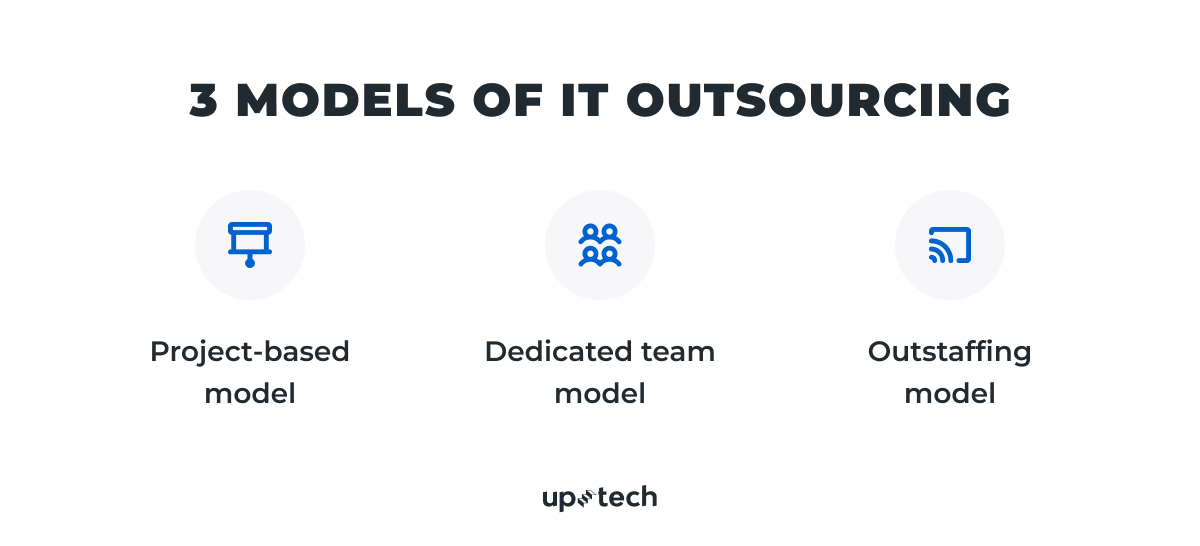
Here are 3 most common IT outsourcing models and their pros and cons.
Project-based model
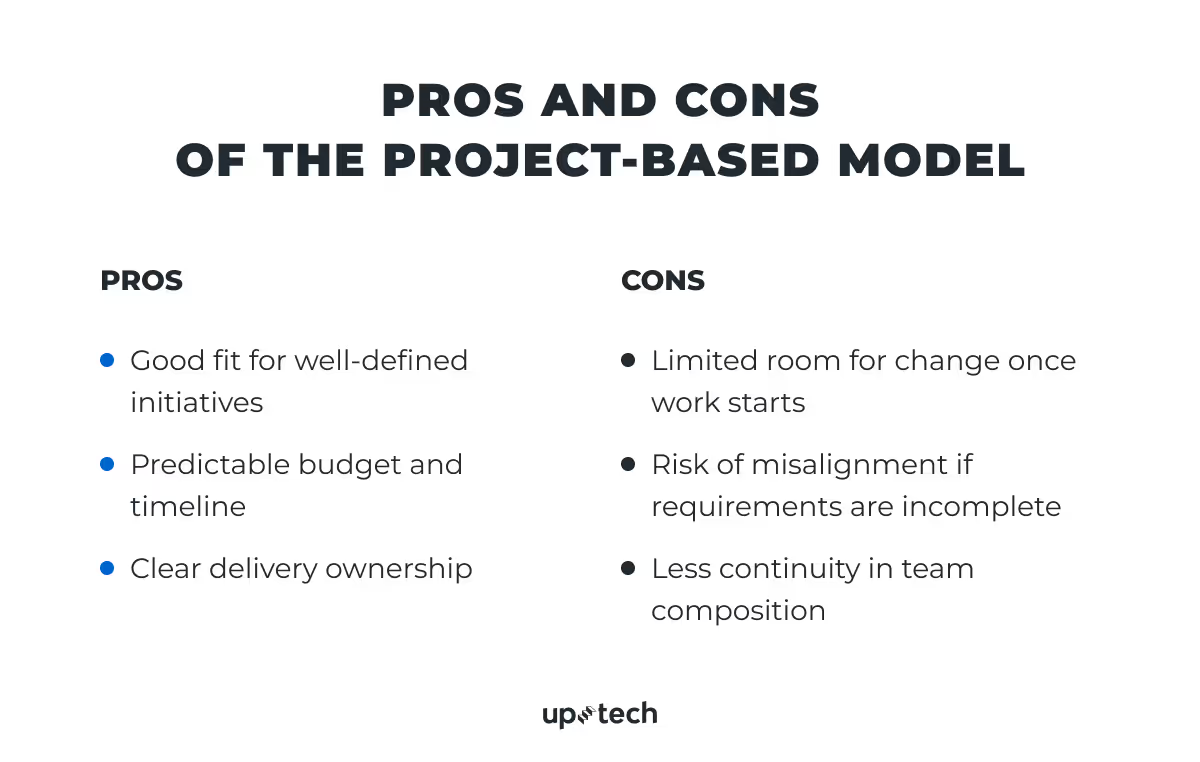
How it works: you hire a team to implement the part of the work that is already planned and defined. The project manager from the outsourced team carries full responsibility for the quality and performance of the project.
When to use: the project-based IT outsourcing model is suitable for not complicated projects that have predictable and well-studied functionality.
Dedicated team model
How it works: you hire a team that will create a project for you, and they will work only on that project. Unlike the project-based model, a dedicated IT outsourcing team is more engaged in your project. In this model, an outsourced team becomes your technical and product advisor. So it can offer ideas and suggest alternative solutions.
When to use: the dedicated team IT outsourcing model is best for early-stage startups that are expected to grow, complex long-term projects that have the potential to expand, and projects with many evolving requirements. If you want to validate your idea, find a product-market fit, or build an MVP to test the market, the dedicated team is the way to go.
We at Uptech often focus on a dedicated team model. Our case for real estate app Yaza is a great example of how a full-cycle software product development company works.

The client came up with an idea to create a utility tool for navigating experiences found in the real world. Instead of a simple implementation of the concept, we went further.
Our product management team validated the initial idea, found product-market fit, and increased the audience. The design team used an iterative approach. All in all, we succeeded in releasing the up-to-date product with the best UI solutions.

Outstaffing model
How it works: it's a type of outsourcing IT when you don't need a full-fledged development team and hire separate specialists. Sometimes the project requires finding a couple of additional professionals, and you're free to hire outstaff workers to cover that scope of work.
The demand for this IT outsourcing cooperation model has grown steadily, with global revenue from IT services projected to hit $1,570 billion by 2027. In 2023, web development leads the chart for top in-demand IT skills, with DevOps and database software professionals as runners-ups.
When to use: the outstaffing IT outsourcing model best suits short-term projects or businesses that lack specific knowledge and need extra hands to scale their business fast.
Here are 2 cases when you can get the maximum benefit:
- When you lack in-house resources and need extra hands to develop a product, choose IT outstaffing.
- When you lack product expertise and need a product development team (product managers, designers, developers, QAs) to build your product, choose IT outsourcing.
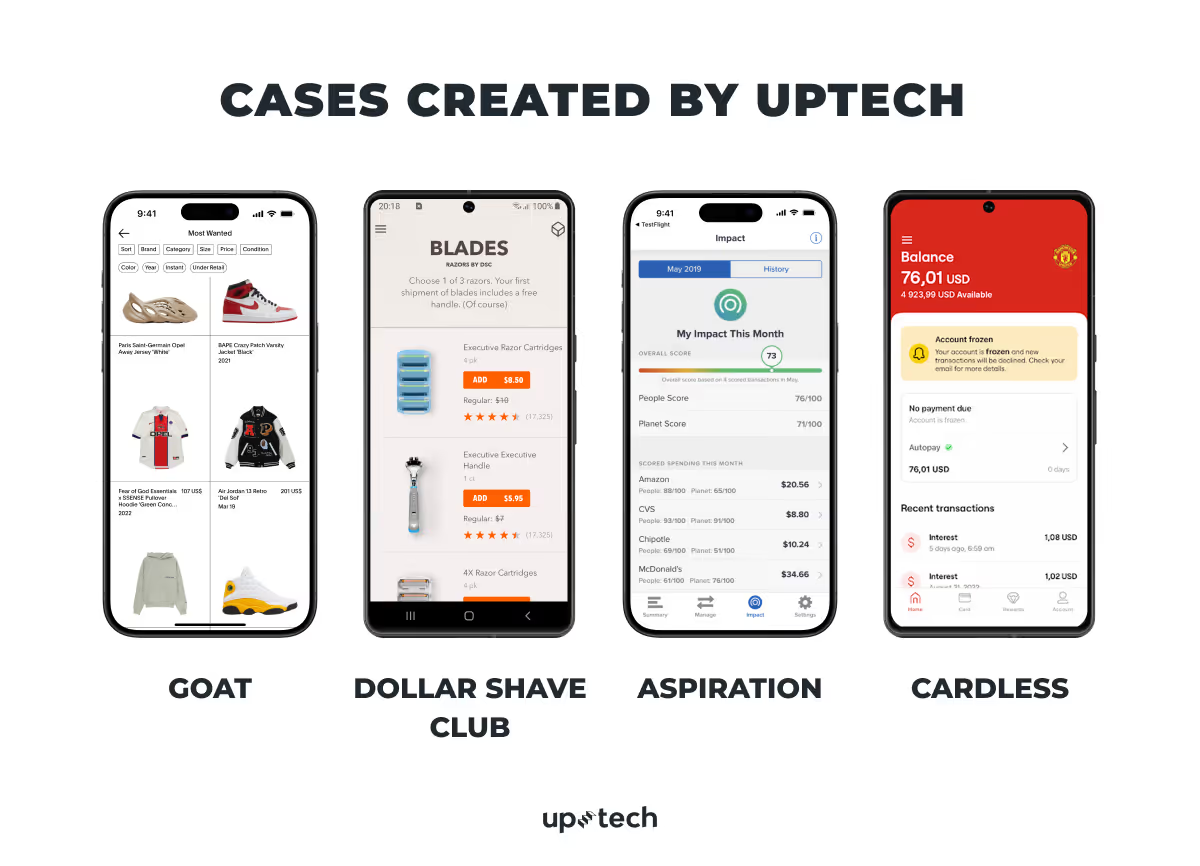
At Uptech, we provide IT staff augmentation services to help teams scale with precision. Over the past 10 years, we’ve helped 200+ companies in various fields turn their ideas into marketable products. Among them are GOAT, DSC, Aspiration, Cardless, and more.
Our team consists of multidisciplinary experts, and we practice the Agile development approach to remain flexible and efficient when designing, testing, and improving apps. So you can be sure that your product is in reliable hands.
Want to learn more about IT outstaffing? Check our article.

Key Benefits and Risks of IT Outsourcing Services
IT outsourcing is best understood as a strategic operating choice rather than a delivery tactic. It affects how companies absorb uncertainty, allocate responsibility, and balance speed with control across their technology function.
Key benefits
- Access to external execution maturity. Established outsourcing partners bring refined delivery processes, governance practices, and quality controls that many organizations take years to build internally. This can raise execution discipline without requiring internal organizational change.
- Risk distribution across organizations. Outsourcing shifts part of the delivery risk, such as staffing gaps, process breakdowns, or tooling inefficiencies, outside the company, reducing the impact of internal disruptions on ongoing initiatives.
- Faster entry into unfamiliar domains. When entering new markets, regulatory environments, or technical domains, outsourcing reduces exposure by relying on teams that have already navigated similar constraints and failure patterns.

Key risks
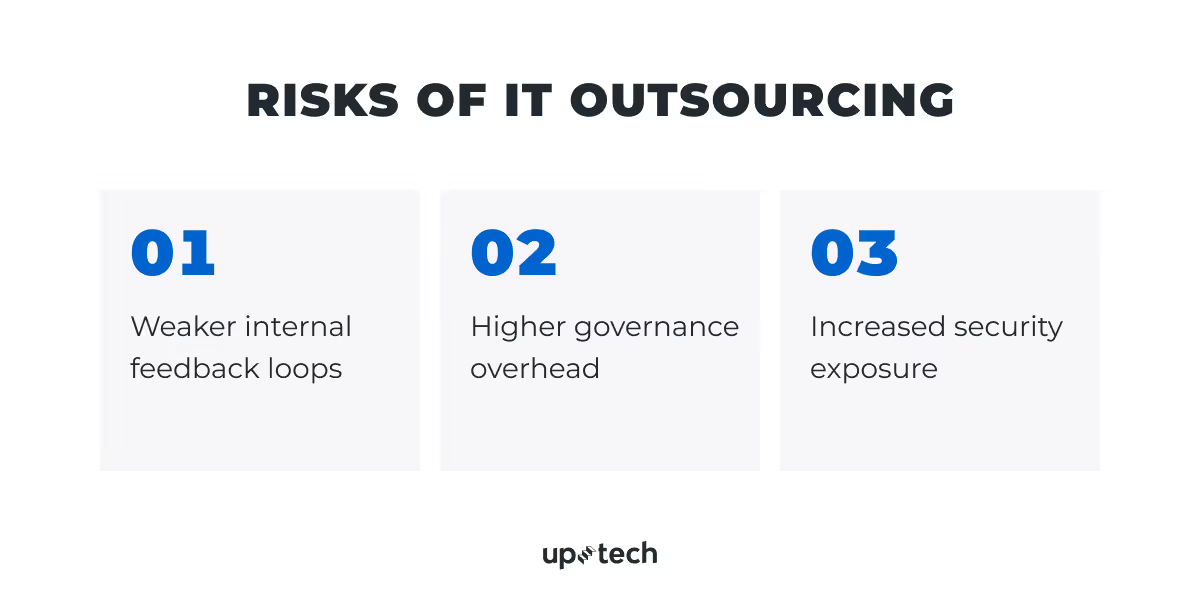
- Weakened internal accountability loops. When execution is externalized, feedback between business outcomes and technical decisions can become less direct, making it harder to learn from mistakes or successes.
- Expanded governance and oversight. Outsourcing requires stronger contracts, monitoring, and performance management to maintain alignment, adding overhead at the leadership and operational level.
- Security and compliance amplification. Sharing systems, data, and infrastructure across organizational boundaries increases exposure to compliance breaches, audit complexity, and security incidents unless controls are continuously enforced.
In-House vs. Outsourcing vs. Hybrid: Strategic Comparison
3 Scenarios Where IT Outsourcing Helps
Now that you know what IT outsourcing is, its models, and types, it's time to clarify why you need to outsource and whether you really need it.
Let's go over a few situations that suggest when to opt for IT outsourcing.
You are a domain expert with an idea
If you're an industry expert with an idea that solves a real problem, IT outsourcing is your choice. In this case, your main goal is to enter the market and test the solution fast. An outsourced team will help you validate the idea, build an MVP to check the hypothesis, and implement changes in your product according to market needs. It saves you money, time, and lets you reach the goal.
You have an early-stage startup
It's a common case that young startups spend money faster than they get a solid team and a ready-to-market product. The Failory found that financial problems are the 3rd reason why startups fail. So it makes more sense to reduce costs by hiring an outsourced team of professionals while your business lives on investors' money. You may employ a full-cycle product development studio covering all the blind spots and bringing your product to life.
You need technical support
Even if you already have a ready solution, but it demands some technical improvements — frameworks for backend components, a new language, integrations with enterprise apps, UX&UI design solutions, it makes more sense to find an experienced partner. There are many functions that IT outsourcing can cover, and again, it saves you the time you'd otherwise spend on looking for qualified staff.

What Are the Most Commonly Outsourced IT Services?
Companies tend to outsource IT services that are resource-intensive, require specialized skills, or can be clearly defined and delivered under repeatable processes. While outsourcing can extend across nearly any technical function, certain areas appear far more frequently because they combine execution scale with clear operational boundaries.
Software development and application engineering
Software development remains the most commonly outsourced IT function. Companies frequently rely on external teams for web, mobile, and backend development services tied to new products, feature expansion, or modernization efforts. Outsourcing is often used to increase engineering capacity quickly, access specific frameworks or platforms, and run development in parallel without committing to long-term hiring.
Typical scopes include MVP development services, feature delivery, legacy system upgrades, and API integration.
In a recent engagement, our team supported the development of an iOS and web platform for independent musicians — Feeture, helping the client move from concept to launch without building a large in-house team.

The work covered discovery, custom mobile and web development, QA, and ongoing support. Since launch, the platform has reached 7.5K+ downloads, built a base of 3.5K+ monthly active users, and continues to onboard 100+ new artists each day, illustrating how outsourced software development can accelerate delivery while sustaining early growth.
Check out more case details here.
IT infrastructure and cloud management
Infrastructure and cloud operations are often outsourced due to their complexity and continuous availability requirements. These functions demand round-the-clock monitoring, specialized tooling, and deep platform expertise that many companies prefer not to build internally.
Commonly outsourced services include cloud app development services, cloud migration and setup, infrastructure monitoring, DevOps and CI/CD management, and performance optimization.
Quality assurance and software testing
Software testing and quality assurance services are frequently handled by external teams because it requires dedicated processes and independent validation. Outsourced QA teams operate separately from development, helping identify issues that internal teams may overlook when working against tight delivery timelines.
Typical services include manual and automated testing, performance and load testing, security testing, and regression testing during release cycles.
In Uptech’s work with Presidio Investors, QA focused on data accuracy validation, edge-case document handling, and integration testing across AI and CRM workflows.

Dedicated testing cycles ensured OCR outputs remained consistent across varied document formats and that automation logic handled incomplete or non-standard inputs reliably, supporting a system that reduced manual work by 80% while processing 100+ deals per day.
Check out more case details here.
Cybersecurity and information security services
Cybersecurity is increasingly outsourced due to its specialized nature and rapidly changing threat landscape. Many organizations supplement internal security teams with external providers that focus exclusively on monitoring, testing, and compliance.
Outsourced security services often include vulnerability assessments, penetration testing, security monitoring and incident response, compliance support, and risk audits.
Data, analytics, and AI-related services
Data science services, MLOps services & consultancy, and AI initiatives are commonly outsourced because they require advanced skills that are expensive and difficult to hire at scale. External teams are often brought in to design and implement systems rather than own the data itself.
Typical engagements include data engineering, analytics and reporting, machine learning model development, and AI integration into existing products. In most cases, companies retain control over data governance while outsourcing execution and optimization.
In one healthcare-focused engagement, our team delivered a medical documents processing system that automated the extraction and structuring of data from complex clinical documents using OCR, NLP, and custom AI models. By outsourcing AI development and data engineering, the client was able to modernize document-heavy workflows without building an in-house ML team.
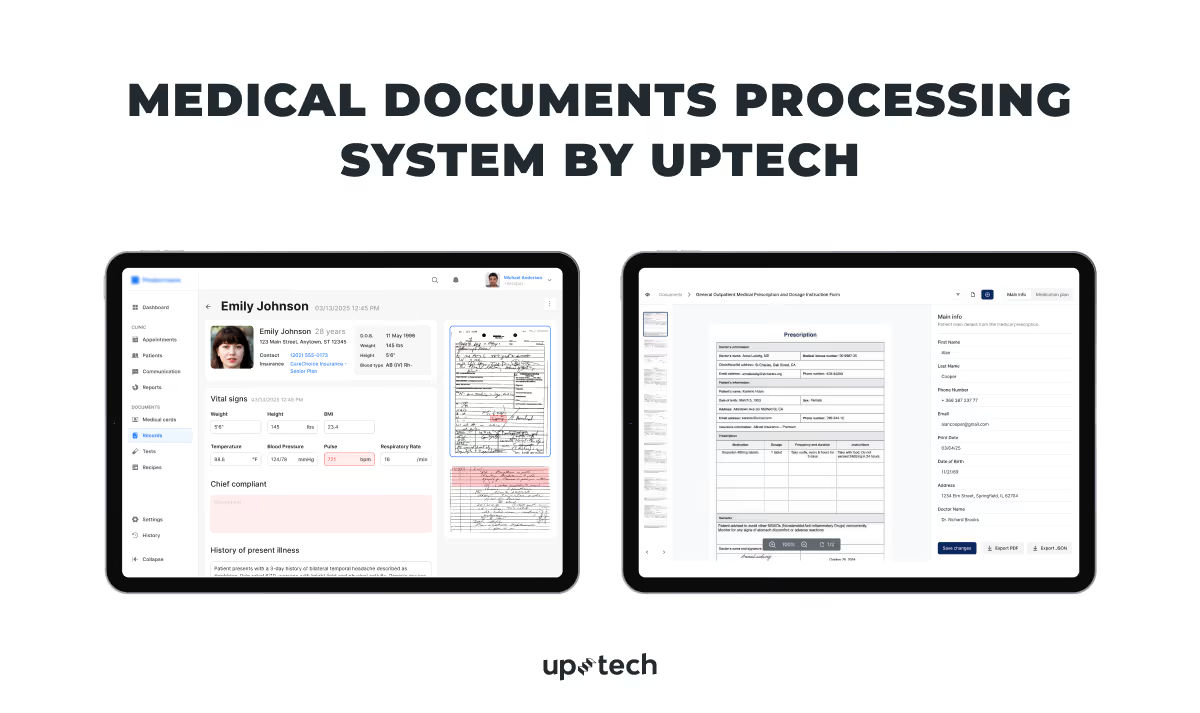
The system reduced document processing time by up to 30% and improved data consistency across clinical operations, illustrating how outsourced AI execution can translate directly into operational efficiency.
Check out more case details here.
Real-world IT outsourcing examples from big companies
According to Clutch, 70% of SMBs planned to expand outsourcing in 2025, prioritizing external expertise in marketing, AI consultancy and services, and general IT assistance.
For entrepreneurs, especially startup founders, IT outsourcing can be the key to propelling their business forward faster and saving more money than they could with a small in-house team.
Big companies also outsource some part of their work as it allows them to hire professionals with different expertise.
Cargill
Cargill, the global commodity trader, recently announced plans to expand its technology workforce in India, focusing on hubs in Bengaluru and Gurugram. The expansion targets roles in data engineering, analytics, and artificial intelligence and builds on Cargill’s long-standing outsourcing relationships with major IT services firms.
Jaguar Land Rover
Automaker Jaguar Land Rover has taken a similar approach, signing a large-scale outsourcing agreement with Tata Consultancy Services to manage and transform its digital and IT estate. The scope included core infrastructure such as networks and cybersecurity operations. The partnership was deeply embedded in day-to-day operations — so much so that a later cybersecurity incident had a direct impact on incident response processes linked to the outsourced environment.
Lloyd’s of London
In the insurance sector, Lloyd’s of London has also outsourced parts of its technology operations. As part of a broader modernization effort, the insurer restructured its technology and operations teams and outsourced selected IT services and operational support.
Under this strategy, Accenture was set to take responsibility for significant portions of Lloyd’s IT services starting in April 2025, supporting a shift toward a more standardized and scalable technology setup.

Why Outsource IT to Uptech?
Words matter, but results matter more. Here’s why companies choose Uptech as their outsourcing partner:
- 10+ years on the market
- 200+ successfully delivered projects
- 10 in-house products built
- ISO/IEC 27001 certification
Uptech is a software development company focused on healthtech, fintech, and AI-driven solutions — industries where mistakes are costly, and quality is non-negotiable.
In these high-stakes domains, clients rely on our ISO-certified workflows, strong technical judgment, and ability to move fast without compromising reliability or compliance.
We have deep experience building compliance-sensitive applications and platforms, and we’re comfortable working at the intersection of technology, regulation, and business requirements.
Our portfolio includes mobile apps and AI solutions for private clinics, telehealth platforms, and fintech products, including projects for MicroGenDX, Angler AI, and others.

Beyond delivery, we focus on partnership. We work as an extension of our clients’ teams, not just as a vendor, prioritizing transparent processes, clear communication, predictable timelines, and flexibility as products grow.
Want to see how this works in practice?
Book a free meeting to discuss your project.
Conclusion
IT outsourcing is increasingly used as a delivery strategy, not just a cost decision. It gives companies a way to access skills and scale execution without permanently expanding internal teams.
The outcome depends less on location or pricing and more on how the relationship is set up — clear ownership, defined responsibilities, and a partner who understands the business context behind the work.
For teams evaluating outsourcing, the key question is not whether to outsource, but how to structure it so it supports real delivery goals rather than adding complexity.





























.avif)