Outsourced product development used to be an unfamiliar business maneuver, but now it is a common strategic move amongst companies of all sizes. It is a time-tested approach that allows startup founders to release functional software to the market in a minimum time while sparing them time to focus on other core business functions.
According to Dataintello’s 2025 report, the global application outsourcing market is on track for strong expansion. The market is expected to grow to USD 180 billion in revenue by 2032. This rise reflects the growing need for cost-efficient, scalable IT solutions and the continued shift toward digital transformation and higher operational efficiency across industries. In this article, I’ll show you how to successfully outsource software product development and be competitive in the market.
What Is Outsourced Product Development?
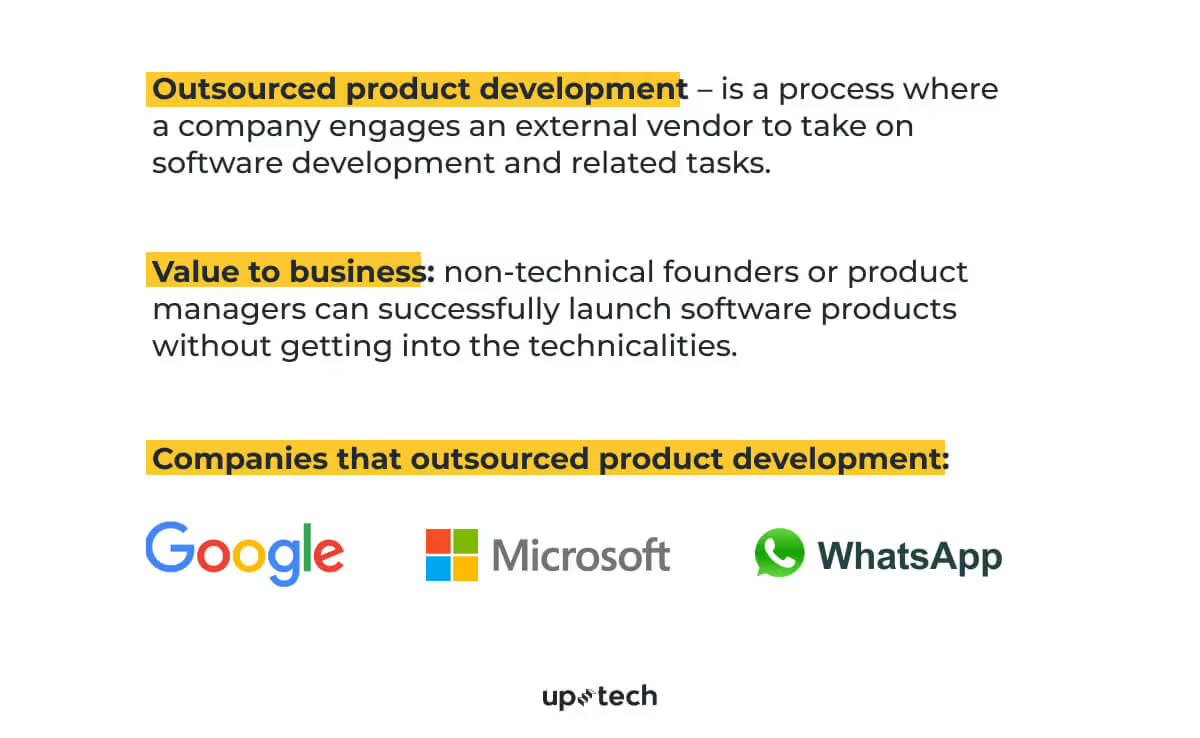
As the name implies, outsourced product development is a process where a company engages an external vendor to take on software development and related tasks. Software product development outsourcing allows non-technical founders or product managers to successfully launch software products without getting into the technicalities of doing so.
While outsourced software product development services have become increasingly trending during the pandemic outbreak, it is a practice that has been ingrained in the business community for years afterward. Some global brands, including WhatsApp, Google, and Microsoft, outsourced their software development needs at certain points in their growth stages and continue to do so.
For example, WhatsApp engaged Eastern European developers to work on its app during the early years to save costs and gain access to top expertise. Meanwhile, outsourcing product development remains an ongoing practice for Google as the search engine giant seeks to tap into the global talent and provide support for in-house employees.
Outsourced Product Development: Benefits for a New Project
Entrepreneurs embarking on their pioneer projects often face the dilemma of hiring an in-house team or contracting outsourced product development services. Uptech experience shows that founders greatly benefit when working with an outsourced product development company instead of recruiting.
A startup must be agile and ready to adapt quickly to changing markets. Despite the control an in-house team offers, founders are better served by the outsourcing model. The latter keeps overhead low and allows them to retain a lean team structure.
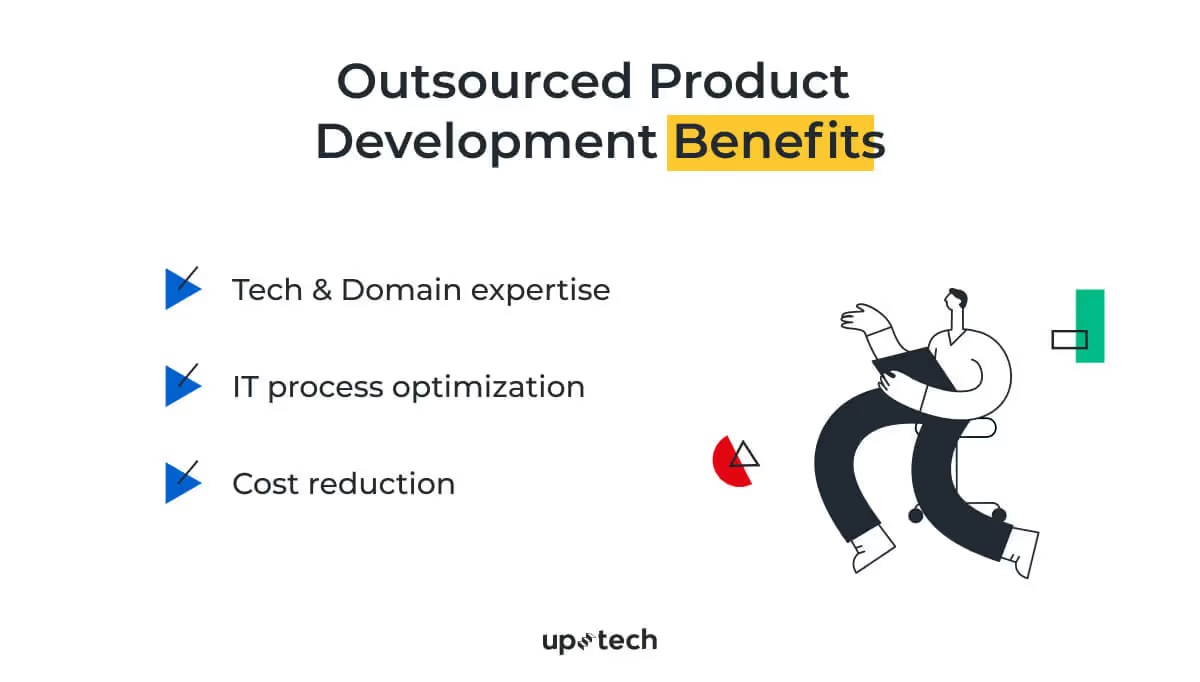
These are the top reasons why so many business owners choose to outsource software product development.
Tech & domain expertise
Developing a functional and engaging app takes more than one programmer. Depending on the type of project, you might require a UI/UX designer, front-end developer, back-end developer, data engineer, project manager, QA test engineer, or even the entire data science team.

Each role involves unique and varying skill sets that take years of experience to master. For example, while some back-end developers are more proficient in Laravel and Django, others use Express.js and Ruby on Rails as frameworks to build backend services.
Modern products also rely on AI features (whether these are predictive analytics models, recommendation engines, or LLM-powered workflows). Outsourcing gives you immediate access to engineers experienced in model integration, cloud AI services, fine-tuning, and building reliable AI pipelines.
If you don’t know what AI feature your software needs or whether or not you should even implement it, opt for our AI consulting services.
Outsourcing software product development helps you overcome the local talent crunch and tap into the vast and diverse talent in different regions.
Outsourcing also gives you access to domain expertise, which is just as important as tech skills. Experienced teams bring a clear understanding of regulations, data flows, compliance requirements, and industry-specific user journeys.
At Uptech, we’ve built solutions across healthcare, fintech, and other regulated domains.
For example, we helped MicroGenDX create a B2C healthcare platform with mobile apps and an admin panel for lab test ordering, sample registration, and result access. The system is HIPAA-compliant and designed to scale in the US and EU markets.
With an outsourcing partner that brings both technical and domain knowledge, you reduce delivery risks, speed up development, and get a product aligned with the expectations of your industry, not just the code behind it.
IT process optimization
App development takes more than writing code and piecing together multiple software components. All successful apps go through streamlined processes that begin with ideation and continue even after app release.
At Uptech, a typical app development goes through the following stages:
- Project discovery. We analyze your product idea, user needs, market context, and business goals. At this stage, we identify risks, define core features, and outline the project scope so you have a clear direction.
- Feasibility study. We evaluate the technical, financial, and operational feasibility of the product. The team reviews architecture options, required integrations, compliance needs, and potential constraints to confirm the solution is viable.
- Prototyping. We create interactive prototypes to visualize the user experience and validate the main product flows. This step helps you see how the product will work before development starts and allows early feedback.
- Software development. Engineers build the app’s front end, back end, database structure, and integrations. We follow an iterative approach, delivering features in short cycles so you can track progress and make adjustments when needed.
- Testing. QA specialists run functional, performance, usability, and security tests to verify that each component works as intended. The goal is to detect issues early and deliver a stable, reliable product.
- Post-release improvement. After launch, we monitor app performance, collect user feedback, and implement updates or new features. This helps the product stay competitive and continue to provide value as user needs evolve.
Each software stage is broken down further into smaller, detailed subprocesses. Sometimes you may not need the entire cycle but only a specific part of it, so we offer services tailored to individual stages as well. Here's the full list of outsourced product development services we offer.
Inexperienced founders are likely to struggle when putting newly-hired developers into an untested workflow. Instead, outsourcing ensures that the software development is taken by a well-coordinated team familiar with established processes and best practices.
Our team works confidently with different development methodologies. We use the Agile methodology when it fits the project best, or adapt to your existing workflow if you already follow another approach.
Cost reduction
In developed Western countries, hiring local software developers can stretch the budget to the limit. This isn’t a wise move for bootstrapped startups, as the funds are equally crucial for marketing, operations, and other purposes. Outsourcing provides a cost-efficient alternative to building an app while meeting established financial goals. According to Deloitte, 70% of companies surveyed cited cost reduction as a major motivation for outsourcing. The latest Deloitte Global Outsourcing Survey 2024 confirms that cost reduction remains a primary driver, even as companies increasingly prioritize access to skilled talent and greater delivery agility.
For a start, you’re spared from paying the in-house team a fixed salary and other benefits. Furthermore, you can save expenses on the workspace, hardware, and software licenses when working with outsourced product development companies. Due to these and other reasons, many startups as well as mid-sized and enterprise-scale businesses turn to Eastern Europe for their outsourcing needs because Eastern European developers offer a balance of quality, cultural similarity, and affordability. Outsourcing product development companies from Eastern Europe set an hourly rate of $35-$60, which is attractive compared to the higher cost of hiring developers in Western countries.
Uptech is an international software development company. We provide a team of experts who work fast, bring valuable suggestions, and maintain high quality. With us, you can scale up your team to meet business needs. Contact our team if you need extra hands to speed up your project!
Forward-thinking startups should also anticipate the huge, recurring expenses of an in-house team even after the product’s development is largely completed. Founders will find themselves issuing monthly paychecks to an idle development team. Letting these permanent hires go is not easy, particularly in Europe, as you’ll navigate through a complex series of local legislations.
The 5-Step Process of Outsourcing Product Development
Arguably, outsourcing to offshore software developers is less complicated than managing an in-house team. You don’t need to supervise the development process yourself, because an outsourcing partner provides project management and handles the team. The only exception is a dedicated team model, where the client stays involved in product decisions.
What the client does need to do is attend demos, answer questions, and provide feedback on time. This helps the team meet expectations more precisely and keeps the loop small, so any changes stay clear and affordable.
That’s why a clear process of outsourcing software product development, broken down into clear steps, is a must. It helps you avoid confusion and move the product forward.
Here are 5 steps on how to outsource product development.

Step 1. Define your goals
First things first, be clear with your requirements before you search for potential offshore developers to work with. Some founders are hunting for expertise to build an app from scratch, while others might want to add new features to existing software, e.g., integrate ChatGPT capabilities or add an admin panel. List down your project needs, as it helps you find the right vendor with prior experience or skill sets.
When you check a portfolio, compare the type of product you want to build with what the vendor has delivered before. At Uptech, we know that each product category requires its own expertise, process, and level of domain knowledge. On one side, we have simple mobile apps that require solid engineering but no compliance or complex workflows. On the other hand, we have healthcare platforms where the team works with medical data and HIPAA requirements. These projects demand strict security controls, medical domain knowledge, and a careful validation of every user flow.
This is why founders should always match their goals with the vendor’s real-world expertise. If you need regulated healthcare software, look for a partner with hands-on experience in that domain, since these projects have specific compliance and data handling requirements.
Step 2. Choose a partner
There is no shortage of software development firms specializing in the outsourcing model. However, finding one that demonstrates trustworthiness and has an excellent track record involves performing due diligence. Check out testimonials from other clients and ensure they match what the potential vendors pitch to you. A reliable company shows the same story everywhere, not two different versions.
Referrals also say a lot about the quality of collaboration. At Uptech, many new clients come to us through recommendations from existing partners. This happens only when people feel confident about the quality of the work, the communication, and the overall process.
Here is what one of our clients shared:
“Uptech is a great partner for software and web development projects. I was impressed with the talent level for each of the roles, including design, front-end, and back-end.” Indy Sheorey, Co-founder & CTO, Angler AI
Angler AI is a customer growth platform with AI-based prospect data enrichment. Our team helped them build an AI-powered web application that supports sales teams with automated lead insights. This type of project demands strong engineering talent, a clear process, and the ability to work with AI pipelines, which is exactly what founders should look for in a long-term partner.
A strong portfolio, transparent communication, and positive references give you a clear signal that the vendor knows how to deliver on real projects, not only present slides.
Step 3. Choose a model of collaboration
Outsourced development firms usually offer several models to help startups remain competitive in fast-moving environments. Decide if fixed-cost, time and material, or hiring a dedicated team works best for you. Consider the financial implications, timeline, and the project’s volatility when deciding on an outsourcing model.
In practice, you will usually see three main options:
- Fixed cost. This option works best for small, well-defined scopes. You know exactly what you want, the requirements are stable, and you care about a clear budget and deadline. For example, a simple MVP with a limited feature set or a ready UX/UI redesign for a specific flow.
- Time and material (T&M). The second option fits products where the scope may change, and you want flexibility. You pay for the actual time the team spends. This model works well for discovery phases, AI experiments, and projects where you expect new ideas after user feedback.
At Uptech, many AI initiatives and early-stage fintech products start in T&M, because founders test hypotheses before they lock the scope.
- Dedicated team. The third cooperation model suits long-term products that require stable capacity and continuous development. You get a cross-functional team that works as an extension of your in-house staff. This is a common choice for complex healthcare platforms, investment tools, or marketplaces that grow feature by feature. For example, when we work with clients on ongoing healthcare or AI platforms, a dedicated team helps keep context inside the team and move faster.
It’s worth noting that this model also requires active involvement from you as a client, since product ownership and strategic decisions stay on your side.
If you are unsure, start small. Many founders begin with T&M for discovery or first features, and then switch to a dedicated team once the product roadmap is clear.
If you have any questions, feel free to contact us about it.
Step 4. Agree on communication rules
Clear, seamless communication is pivotal in ensuring that your project is progressing as per the agreed schedule.
It’s also important to define who is responsible for what. You need to know the name of your project manager, who reviews designs, who answers technical questions, and who signs off on final decisions. This removes confusion and speeds up work.
Agree on the format of updates. Some teams prefer weekly calls with detailed demos. Others choose shorter syncs but more frequent written updates.
You can also discuss response time expectations. For example, you may agree that both teams reply within business hours or within a few hours for blockers. These small rules prevent delays and keep the product moving forward.
Step 5. Formalize the partnership
When you’re satisfied with a particular vendor, it’s time to strike up an agreement and spell out the terms in a clear manner. Ensure that both parties understand the contract before kicking off the collaboration officially.
The agreement usually covers the scope of work, deadlines, payment terms, ownership of the code, and responsibilities on both sides. We can also include a non-disclosure agreement if you want to protect confidential information about your product, investors, business model, or internal processes. Most startups sign an NDA before any work begins, especially in healthcare, fintech, AI, and other sensitive domains.
At Uptech, we respect these agreements fully. If a client asks to keep the project private, we do not disclose their name or share the product publicly. Several companies we work with run in regulated environments, so confidentiality is not optional. It is a normal part of the partnership.
A well-structured contract and NDA protect your product, create clear expectations, and remove the fear of surprises later in the development process.
Outsourced Product Development: Uptech Case Studies
Our team has demonstrated competency, teamwork, and timeliness throughout the years as we helped various startups bring their ideas to life. Not only do we consider technical requirements, but our team also shows aptitude in understanding the business goals of the respective founders.
These are some more works we’ve done for business owners in different countries and industries.
Presidio Investors: AI product development outsourcing
Presidio Investors is a US-based investment firm that helps individuals and companies manage and grow their capital. They needed a faster way to work with investment data. Their analysts spent too much time processing documents, reading emails, and updating the CRM manually. So Presidio Investors reached out to us after hearing about our investment automation work on Tired Banker and wanted a partner with real AI expertise.
Our team built an AI-powered system that analyzes documents, extracts key information, structures the data, and uploads it to their CRM automatically. The solution works with PDFs, scanned images, charts, and emails. It runs on Azure OpenAI Service and AWS, so all data stays secure and compliant.
The result is a significant shift in productivity. Manual work dropped by 80 percent, and the team now reviews up to 100 deals per day with clean, structured insights delivered by AI.
Yaza: Product design outsourcing
Yaza is a real estate app allowing property agents to share home listings and 3D virtual tours. The client tasked us to build the Yaza mobile app from scratch based on specific business requirements.
Upon taking on the project, our team initiated hypothesis validation, where we tested the proposed ideas against audience feedback. The consistent and genuine feedback proves pivotal for our UI/UX designers to hone in on possible difficulties and issues.
We fixed every uncovered issue by breaking the validation process into small, iterative steps before moving on to the next stage. This allowed our team to ensure that the app is continuously updated with UI elements that provide an optimal customer experience.
Nomad: Product discovery outsourcing
Nomad is another innovative property hunting app that fulfills European and Middle Eastern market needs. The app allows customers access to a personalized property listing and connects them with the appropriate agents seamlessly.
As Nomad is a pioneering initiative in the region, the app must be tailored to solve the user’s problem. Throughout the development stages, our team applied continuous discovery to ensure that the deliverables were aligned with actual user needs.
We ensure that every hypothesis is proven with customer feedback to shape and improve functionalities and features in the design stage. Our efforts translated into a well-received app that has become a favorite amongst home buyers.
Dollar Shave Club: Android development outsourcing
Dollar Shave Club is a US-based startup that sells men's grooming products online. The company has a functioning app but requires a major revamp to keep up with modern trends and requirements. This collaboration demonstrates how Uptech can maintain strong communication and work seamlessly with our technical counterpart.
Dollar Shave Club's major makeover starts with meticulous planning and discussion amongst our team and the client. We mapped out the new app's milestones, estimates, and features. Our developers work closely with DSC’s internal team to introduce new features that significantly elevate customer engagement.
Plai: MVP development outsourcing
Plai is a performance management app that allows managers to automate employee appraisals in small and medium-sized companies. Our success in this project is a testament to our ability to build an MVP within the stipulated timeline and on a modest budget.
With so much at stake, we turn to the target users to ensure that Plai turns out to be a fitting product for the market. Our team interviewed the potential users to understand their pain points. This becomes a compass to structure the app’s roadmap and ensure the app is ready for further investment opportunities.
.avif)
Summary
Outsourced product development is and will continue to be a preferred hiring model for the startup community. You save precious time and cost and gain access to a vast talent network when you outsource product development to offshore vendors. Uptech has a strong portfolio where we’ve helped dozens of founders to design, develop, test, and align their apps to market needs.
Explore your ideas with us and reduce the time to market with our team of software experts.





























.avif)