Mobile health apps have moved from a nice extra to a daily tool. In 2024, 320 million people used health apps to track symptoms, manage medication, or monitor nutrition. If you plan to develop healthcare-related software, you need a healthcare app development cost before the project starts.
The cost to develop a healthcare app in 2026 varies widely. A focused MVP may start around $40,000, while a full-scale platform with advanced features and strict compliance requirements can exceed $300,000. The difference comes down to product complexity, feature depth, and regulatory requirements. All of this shapes the scope and the budget from day one.
I’m Denis Gaiduchek, Head of Delivery at Uptech. In this article, I explain how much it costs to develop a healthcare app, what drives the price, and how to plan the budget with fewer surprises. The goal is to give healthcare providers, startups, and product teams a clear cost baseline before they invest.
How Much Does It Cost to Develop a Healthcare App?
Healthcare app development covers mobile and web products that support medical services and patient care. These apps help patients, doctors, and healthcare organizations communicate, manage data, and deliver care through digital channels.
Common examples include
- telemedicine apps for remote consultations
- hospital apps for appointments and test results
- wellness apps that track activity or chronic conditions
Of course, there are quite a few other healthcare mobile app types. Despite the case, there are different factors that always influence both the scope and the price when it comes to building medical software. We will cover them later in the text. For now, we’ll start with app complexity, as it sets the baseline for both scope and development cost.
Healthcare app cost breakdown by app complexity
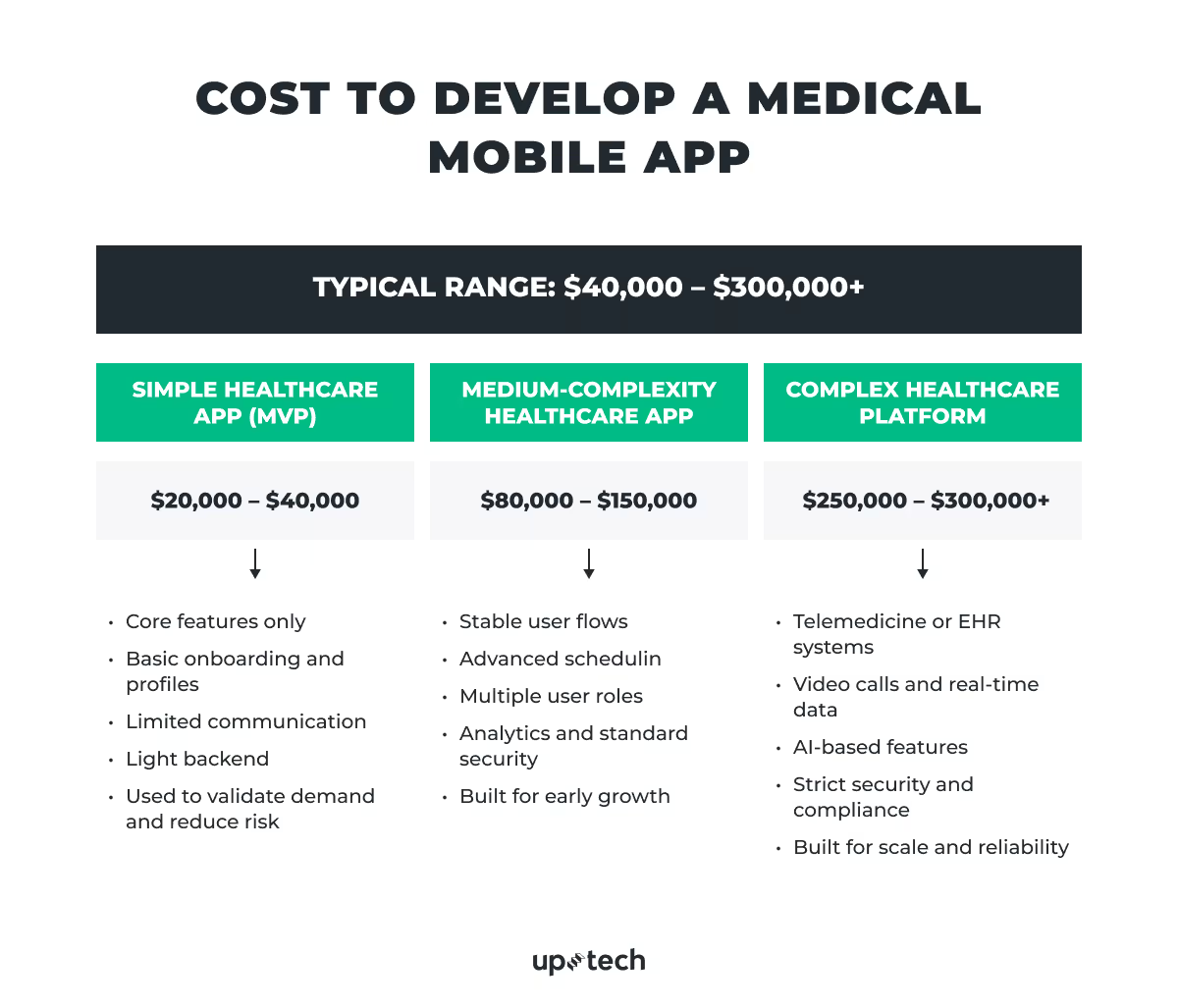
So, as we said, the cost of developing a healthcare app depends on its complexity in the first place. Something as simple as an MVP can cost around $40,000, while full-scale, compliance-heavy medical software usually exceeds $300,000. Let’s take a look at this complexity-price relationship in more detail.
Simple healthcare app (MVP)
Typical cost: $20,000- $40,000
A simple healthcare app is usually an MVP (Minimum Viable Product). It includes only essential functionality and helps teams validate demand before committing to larger budgets. Common features at this stage focus on a single healthcare use case, such as doctor appointment booking, patient intake forms, or access to limited medical records.
We use this approach in our own products. When building Clearly, a mental health marketplace developed as an Uptech’s internal R&D project, we launched first as a small MVP with a landing page, therapist profiles, and basic messaging. After confirming product-market fit, the platform expanded into web and mobile apps with secure video sessions, analytics, and AI-based features.
Starting with an MVP helps control the health app development cost, reduces early risk, and gives teams real data to guide further development.
Medium-complexity healthcare app
Typical cost: $80,000–$150,000
Mid-level healthcare apps go beyond basic validation. They support stable user flows, solid design, and standard security measures. At this stage, products often include advanced scheduling, richer user roles, analytics, and more reliable back-end infrastructure.
Built for early growth, the scope of these apps is wider than an MVP, but still focused enough to avoid unnecessary complexity.
At this stage, products often rely on third-party integrations, such as payment providers, shipping or logistics services, analytics tools, notification systems, or external healthcare services. For many healthcare providers, this level offers the best balance between functionality and investment.
One example is a healthcare company we worked with. We helped build a B2C web platform, a custom admin panel, and native mobile apps for iOS and Android. The solution includes integrations for payments, shipping, analytics, and consent management, along with secure access to test results and internal order workflows.
Complex and enterprise-grade healthcare app
Typical cost: $250,000–$300,000+
Complex healthcare platforms include telemedicine systems, EHR solutions, or products with video calls, real-time data processing, and AI-based features. These apps require longer development cycles, deeper testing, and a wider array of strict data protection measures.
Security, compliance, scalability, and reliability all play a major role here. Teams spend more time on architecture, audits, and quality assurance, which is why the cost to develop a medical app increases significantly at this level.
However, this division into simple, medium, and complex apps is only a general reference point. In practice, the final cost depends on a wider set of factors that we cover further in the text.
One example of a complex healthcare project is an AI-powered prescription automation solution we built for a digital healthcare company in Germany. The solution uses AI to process handwritten and digital prescriptions, unify multiple documents into a single medical plan, and validate data to meet local healthcare regulations. The scope included machine learning, secure data handling, and integration-ready outputs for further automation, all of which significantly increased development effort and complexity.
Healthcare app development costs by app type
Healthcare app budgets vary widely, even for products that look similar on the surface. Below, we break down typical cost ranges by app category and explain what drives timelines and budgets in real healthcare projects.
Telemedicine and remote consultation apps
Approximate cost: $120,000-$280,000
Timeline: 6-9 months
Team: 7-8 specialists
A telemedicine app usually is expected to come with video consultations, real-time chat, scheduling, payments, notifications, and basic patient records. Video streaming alone requires dedicated backend work, load testing, and fallback scenarios for unstable connections. On top of that, teams must implement access control, audit logs, and encrypted data storage to meet healthcare compliance requirements.
A typical team includes 2 backend engineers, 2 specialists providing mobile app development services, a QA engineer, a designer, a project manager, and part-time DevOps support. Real-time infrastructure and security reviews form a large part of the total cost to develop a healthcare app in this category.
Mental health and therapy apps
Approximate cost: $70,000-$140,000
Timeline: 4-6 months
Team: 6-7 specialists
Mental health apps often include session booking, mood tracking, journals, therapist profiles, messaging, and sometimes video sessions. While the backend is usually less complex than in hospital systems, privacy expectations remain high, especially when handling therapy notes and personal data.
Development typically involves 1-2 mobile engineers, a backend engineer, QA, design, and product management. Costs increase when the app includes therapist matching, analytics, or regulated communication features. Even without video, these products require careful data handling and user access control.
Wellness and fitness tracking apps
Approximate cost: $65,000-$160,000
Timeline: 4-7 months
Team: 6 specialists
Wellness apps focus on activity, nutrition, sleep tracking, and integrations with wearables. The main complexity comes from data synchronization, third-party APIs, and device compatibility rather than healthcare regulations.
Teams usually include iOS/Android developers, a backend engineer, QA, design, and a project manager. Costs rise when the app processes data in real time, supports multiple wearable brands, or adds social and analytics features. Testing across devices and OS versions often extends the timeline.
Medical CRM and hospital management systems
Approximate cost: $180,000-$420,000
Timeline: 8-12 months
Team: 7-8 specialists
Healthcare CRM systems handle patient records, scheduling, billing, staff workflows, and internal reporting. These products are rarely standard and often require deep customization and integration with existing hospital software.
Backend development dominates the timeline, supported by frontend or mobile software developers, QA, and DevOps. Security, role-based access, and audit trails are mandatory. Integration with legacy systems and internal tools is one of the main drivers of the healthcare website app development cost in this category.
EHR/EMR systems with patient portals
Approximate cost: $140,000-$300,000
Timeline: 7-10 months
Team: 7-8 specialists
EHR and EMR systems store medical history, lab results, prescriptions, and patient portals. These products must meet strict regulatory standards and support detailed permission models for doctors, patients, and administrators.
Teams spend a significant amount of time on data modeling, access control, and compliance validation. Backend engineers, QA, and security-focused reviews account for a large share of the cost of developing a healthcare mobile app in this segment.
AI-powered healthcare assistants and chatbots
Approximate cost: $120,000-$380,000
Timeline: 6-12 months
Team: 7-9 specialists
AI-powered healthcare products include symptom checkers, medication reminders, and automated support tools. The main challenge is not the interface, but data readiness. In many cases, data is incomplete, inconsistent, or too limited for reliable model training.
Projects often require additional specialists, such as data engineers and ML engineers, to clean, normalize, label, and validate datasets. All PHI must be anonymized and protected before use, which adds both time and cost. Model training, evaluation, and iteration usually happen alongside product development rather than as a one-time step.
Because of these factors, the cost to build a custom healthcare mobile app in 2026 with the AI assistant functionality varies widely and depends heavily on data quality, not just feature count.
Uptech provides all kinds of AI consulting services, so reach out if you have any questions.
What Factors Influence Healthcare App Development Costs
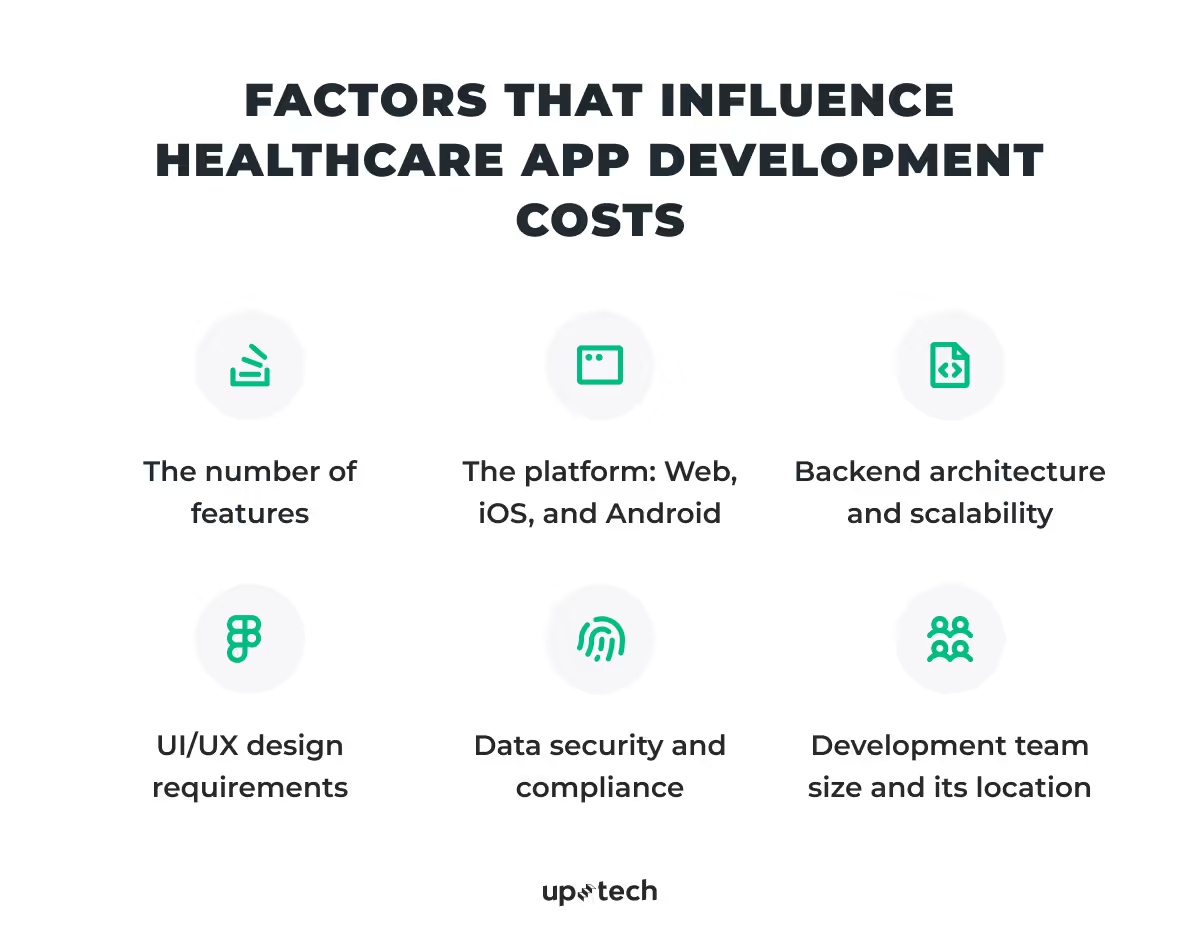
The cost of custom healthcare app development depends on a combination of product decisions, technical requirements, and operational constraints. Two healthcare apps with similar goals can end up with very different budgets based on how they handle features, platforms, security, and long-term support. Below are the key factors that most often define what the price for a healthcare app will be in real projects.
The number of features
First things first, features and their number define the cost of developing a healthcare app more than anything else. A product with core functionality like appointment booking, patient profiles, and access to medical records is easier to scope and faster to build.
Once you add video consultations, secure messaging, e-prescriptions, wearable integrations, or multilingual support, the picture changes. Each of these features brings extra backend logic, third-party services, security layers, and testing effort. The more data the app processes in real time, the more time the team needs to design, build, and validate it.
The most cost-effective approach is to focus on features that support the main use case and leave secondary ideas for later. Modular development helps here. It allows teams to launch faster and extend functionality without rebuilding the core. This way, the cost of medical app development stays under control while the product remains flexible.
The platform: Web, iOS, and Android
The next thing that influences the cost to develop a medical app is platform choice. Building for one platform is always cheaper than building for several at once. Each platform adds its own development, testing, and support workload.
Most teams start where their users already are. If patients mainly use the web, it makes sense to begin there. If the product targets mobile-first use cases, iOS or Android often comes first. Once usage grows and feedback becomes clearer, expanding to other platforms is easier to justify.
Cross-platform tools can reduce part of the effort, but healthcare products still need platform-specific work, especially around performance, security, and integrations. A phased rollout usually leads to a lower healthcare app development pricing tag than trying to cover everything from day one.
Backend architecture and scalability
Backend decisions have a direct impact on the health app development cost, especially as the product grows beyond early users. A lightweight backend can support early functionality and predictable load. Architectures designed for scale usually require higher upfront effort, but they reduce rework and cost when the product grows.
As usage expands, teams need to account for system load, data synchronization, background jobs, and uptime requirements. Healthcare products usually handle multiple user roles, such as patients, doctors, and administrators, which adds logic around permissions and data access. All of this increases the effort required to design and maintain the backend.
Scalability planning also affects infrastructure choices. Cloud hosting, monitoring, backups, and recovery mechanisms are often required to keep the app stable. These elements add both development time and operational overhead, which raises the cost to make a healthcare app, especially for products built with long-term growth in mind.
UI/UX design requirements
Design plays a bigger role in the health app development cost than many teams expect. A clear and predictable interface affects how users interact with the product, how quickly they complete tasks, and how much support the app requires after launch.
Several factors influence design effort. Complex workflows, a large number of screens, and custom interactions all increase design time. Healthcare apps often serve different user groups, such as patients, doctors, and administrators, each with their own expectations and usage patterns. Designing for all of them requires careful planning and validation.
User research and testing also affect cost. Early usability testing helps catch issues before healthcare app development starts, which saves time later. Regular feedback cycles keep the interface understandable and prevent feature overload. Responsive design adds another layer of work, especially when the app must perform consistently across devices and screen sizes.
Accessibility affects scope and cost, too. In most cases, healthcare software products need to meet accessibility standards to support users with visual, motor, and cognitive limitations. This requirement influences color contrast, typography, navigation logic, and screen structure. All of this, in turn, adds design and testing effort.
Data security and compliance
In healthcare, security and compliance are not optional. And of course, these two things have a direct impact on the cost to build a custom healthcare mobile app. Any product that handles medical or personal health data must follow strict rules around storage, access, and data transfer.
In practice, this means you need to implement encryption, role-based access, audit logs, and secure authentication from the start. Compliance with regulations such as HIPAA and GDPR affects both technical architecture and development workflows. For web-based solutions, the same rules apply, which also influences the cost to build a custom healthcare website app, especially when patient portals or administrative dashboards are involved.
On top of all the abovementioned, compliance is not a one-time task. Teams need to account for documentation, internal security reviews, and regular updates as regulations evolve. In some cases, external audits or certification processes add extra time and cost. Ongoing maintenance is also required to keep the product compliant after launch, which increases the total investment over time.
Development team size and its location
Team composition and location will still have a noticeable effect on the cost to develop a custom healthcare app in 2026. Healthcare products rarely rely on a single developer. Most projects require a cross-functional team that includes backend and mobile engineers, QA, design, and product management, with additional support from DevOps or security specialists when needed.
Hourly rates vary significantly by region. In the US and Western Europe, rates commonly range from $80 to $120 per hour. In Eastern Europe, in countries like Ukraine, experienced healthcare development teams typically work in the $40-70 per hour range.
Read our post if you want to learn more about how to find a reliable outstaffing partner in Ukraine.
This difference is driven primarily by local economic conditions, not skill level. The cost of living, tax structures, and operating expenses in Western markets are higher, which is reflected in developer rates. In many cases, teams in Eastern Europe work on the same technologies, follow the same compliance standards, and have comparable experience with regulated healthcare products.
It’s also important to note that development is only part of the total healthcare app development cost. Ongoing expenses such as cloud hosting, video infrastructure, third-party APIs, monitoring tools, and security services can add a noticeable amount to the overall budget after launch.
In the next section, we’ll look at these additional costs in detail and explain what teams should plan for beyond initial development, especially for healthcare products that handle sensitive data and require high availability.
Additional Expenses That Often Come with Healthcare App Development
When teams estimate the cost of developing a health app, they often focus on feature scope and development hours. In practice, several additional expenses affect the total budget. Awareness of these costs early helps avoid surprises after launch.
Infrastructure and cloud hosting
Every healthcare app requires a stable infrastructure. Cloud platforms such as AWS or Azure support data storage, processing, backups, and availability. These services come with recurring costs that depend on traffic, data volume, and system load.
For small apps and MVPs, infrastructure costs usually range from $50 to $200 per month. Medium-sized products often fall between $200 and $1,000 per month. Large platforms with high traffic, real-time features, or video support can exceed $1,000 per month. Setup, scaling rules, monitoring, and backups add to this cost over time.
If the product includes AI features, infrastructure costs increase further. For example, when teams integrate ChatGPT into an app using GPT Realtime, pricing starts at $4 per 1M input tokens and $16 per 1M output tokens, which adds a recurring, usage-based cost on top of standard cloud infrastructure.
Third-party services and integrations
Many healthcare apps rely on third-party services for core functionality. Common examples include video conferencing, messaging, payments, notifications, analytics, identity verification, and EHR integrations.
These services often charge usage-based or subscription fees. Costs depend on the number of users, volume of sessions, or API calls. In some cases, healthcare-specific integrations require custom agreements or enterprise plans, which increase monthly expenses.
Security audits and legal reviews
Healthcare apps may require third-party security audits to confirm data protection and compliance. For small to mid-sized products, audit costs usually range from $5,000 to $15,000. Complex platforms with sensitive data and custom infrastructure may require $20,000 to $50,000 or more, depending on scope.
Security audits are rarely one-time. Initial audits usually take place before launch, but follow-up reviews often occur after major feature releases, infrastructure changes, or compliance updates.
Legal reviews also add cost. Standard reviews of terms, privacy policies, and contracts usually fall between $3,000 and $10,000. Highly regulated products often exceed $20,000, especially when multiple jurisdictions apply. Legal checks tend to repeat when regulations change, the product expands to new markets, or data usage policies evolve.
Maintenance and updates
Healthcare products require regular updates to stay compatible with new OS versions, security standards, and regulatory changes.
Teams must apply security patches, update third-party services, and fix defects reported by users. Feature updates also follow real usage data and feedback from patients and medical staff. Each release requires testing and validation to avoid breaking compliance-related functionality.
Maintenance usually requires a dedicated monthly or quarterly budget. A common planning rule is to reserve 15-25% of the initial development budget for ongoing support.
App store publishing and licensing fees
Last but not least, in case you develop a healthcare mobile app, keep in mind that App stores charge standard publishing fees. Apple requires a $99 annual developer account, while Google Play charges a one-time $25 fee.
These expenses remain small compared to development costs, but they still belong in the overall budget plan.
How to Calculate the Cost to Build a Custom Healthcare Mobile App
By this point, the main health app cost drivers should be clear. Features, platforms, security requirements, and team setup shape the final budget in different ways. Based on these factors, the steps below help form a more accurate cost estimate and reduce uncertainty at the planning stage.
Define all cost-influencing factors
Start with a clear scope. Define required features, platforms, security level, compliance obligations, and expected scale. These decisions set the baseline for the cost to build a custom healthcare mobile app and help avoid scope creep later.
For example, a doctor appointment app may look simple at first. In practice, the scope often includes patient and doctor profiles, appointment scheduling, availability management, notifications, and basic admin tools. If the app requires online payments, insurance details, or calendar sync, the cost increases.
Payment processing usually relies on third-party services. These providers charge transaction fees and, in some cases, monthly usage fees. Integration work also adds development time, especially when security and compliance rules apply. Similar costs appear with other third-party services, such as messaging, video, or identity verification.
Estimate your team size and choose a delivery model
Decide whether you build with an in-house team or want to outsource software development. Healthcare apps usually require a team of experienced specialists, including backend and mobile engineers, QA, design, and product management. Team size, seniority, location, and development time directly affect the final budget.
Use an app development cost calculator
To get an initial estimate faster, use a healthcare-focused cost calculator. Uptech’s App Development Cost Calculator helps you assess the budget based on app type, platform, feature set, and complexity. It provides an approximate range grounded in real delivery experience and works well as a starting point before detailed planning.
If you need help with calculating approximate costs for your healthcare app, you can reach out to our team for guidance.
Conclusion
Any healthcare app requires careful planning, realistic budgeting, and clear tradeoffs. A budget of $40,000 usually supports an MVP with core features. Budgets above $100,000 allow advanced functionality, integrations, and long-term scale. Clear expectations at each stage help teams avoid unnecessary costs.
At Uptech, we approach healthcare projects from a delivery perspective. Our teams work with regulated products and plan for compliance from the start. This approach helps clients control costs without risk to security or product quality.
If you need help with the healthcare app development cost estimates or early validation, reach out to our team. We can review your idea, define the scope, and provide a realistic budget range based on real delivery experience.





































.avif)