The tech field moves fast. Adding very needed software features, launching MVPs, testing product hypotheses — all of that requires a certain skillset and time from the right people.
Those business leaders who want to scale faster than a typical in-house recruiting process turn to hiring dedicated development team. Which makes sense, considering that hiring for many tech roles takes 35–60 days, and up to 89 days for senior or specialized positions.
A dedicated development team model gives companies access to an engaged, long-term technical team without dealing with staffing, payroll, legal overhead, or infrastructure management. For many businesses, this setup becomes a strategic advantage.
It might be a strong fit for you, too — but like any business decision, it isn’t universally right. To make it work, you need to understand the model properly: what it includes, how it differs from other collaboration formats, and where its real advantages (and limitations) lie.
As a business development manager, I’ll put my experience to help you do that. In this article, I’ll explain what a dedicated team model is, its pros and cons, and how it differs from other team formats. I’ll also share some tips on when to hire dedicated development team, and when it’s better to look for other options.
Let’s get started.

What is the Dedicated Team Model?
A dedicated development team is a collaboration model with an outsourced team of developers, where a client and a developer’s team collaborate on a long-term basis. This is one of the most popular collaboration models, which stands on par with the fixed price (FP) and time & materials (T&M) models.
When you opt for dedicated development team services, you get professionals selected specifically for your business goals.
However, unlike with employees, in a dedicated team, you don’t have to bother about administrative, HR, tax, and social benefits issues. On the contrary, you can focus on more high-level business issues while your development partners do the rest.
To sum up, a dedicated development team model provides you with a hand-selected professional team that is focused on realizing one specific project.
Who is in a dedicated development team?
The specific composition of your team depends on your business requirements, development scope, and many other factors. Generally, the dedicated software team may consist of a couple of key roles listed below.
Project Manager (PM)
Project Managers play a key role in maintaining team efficiency and client satisfaction. In a dedicated team model, where stable velocity and predictable output are essential, a PM helps keep workflows organized, blockers resolved, and delivery on track.
Their primary responsibility: Arrange a predictable, organized delivery process where everyone knows what to do, why it matters, and when it needs to be completed.
What they do in practice:
- Plan sprints, track timelines, and coordinate the team.
- Communicate with the client.
- Track budget, manage risks, and report progress.
- Remove blockers and keep delivery stable.
Expected output from their side: Weekly reports, clear plans, smooth execution, no chaos.
Business Analyst
A Business Analyst (BA) is the person who turns incomplete or abstract business ideas into structured, unambiguous requirements that developers can actually work with. Their core value lies in removing uncertainty, preventing rework, and making delivery predictable.
Their primary responsibility: Turn business logic into structured technical requirements.
What they do in practice:
- Gather and refine requirements.
- Map processes, user flows, edge cases, constraints.
- Document functional specs and acceptance criteria.
- Work closely with PM and devs to eliminate ambiguity.
Expected output from their side: Use cases, flow diagrams, and detailed requirements for developers.
UX/UI Designer
UX/UI designers create precise visual and interaction guidance during the development process. They design products’ intuitive flows, clear screens, and a consistent interface that feels natural to your users.
Primary responsibility: Turn requirements into an intuitive, user-friendly product/app design.
What they do in practice:
- Run user research (interviews, surveys, heuristics).
- Create wireframes, flows, prototypes.
- Design final screens, UI kits, interaction patterns.
- Ensure accessibility, usability, design consistency.
- Work with developers to make sure the design is implemented correctly.
Expected output from their side: Clear, complete design handoffs with a unified design system.
Software Developers
In a dedicated team model, they are the core execution force that delivers measurable business value. Every other role exists to enable them to build efficiently and correctly.
Primary responsibility: Build the core functionality of the product and turn requirements, designs, and business logic into working software.
What they do in practice:
- Implement features based on requirements from PM/BA
- Translate designs into real, functioning product behavior
- Integrate external services, libraries, and APIs
- Investigate and solve technical problems, bugs, and edge cases
- Review each other’s code and maintain code quality
- Optimize performance, stability, and scalability
- Collaborate with QA, designers, and PM to refine functionality
Expected output from their side: A reliable, maintainable, high-quality product that works as expected and continuously improves without breaking.

QA Engineers
QA Engineers directly impact delivery speed, product stability, and user satisfaction.
Their primary responsibility: Validate functionality, catch issues early, broken flows, and unexpected bugs.
What they do in practice:
- Write test plans and test cases.
- Test new features manually or via automated tests.
- Check edge cases, performance, usability.
- Verify fixes and regression issues.
Expected output from their side: Bug reports, test suites, stable releases.
DevOps Engineer
In many projects, especially smaller ones, DevOps responsibilities are handled by software developers. They set up CI/CD, manage basic cloud infrastructure, and keep deployments running smoothly.
However, for extensive systems, multi-environment architectures, or products with high uptime and security requirements, the workload becomes large enough to justify a dedicated DevOps role.
Primary responsibility:
Provide automated, secure delivery of your product from development to production with minimal downtime, friction, or manual work.
What they do in practice:
- Set up CI/CD pipelines to automate building, testing, and deployment
- Manage cloud infrastructure (AWS, GCP, Azure) and optimize environments.
- Implement Infrastructure as Code.
- Configure monitoring, logging, and alerting systems.
- Ensure system security, backups, redundancy, and disaster recovery.
- Collaborate with developers to streamline releases and resolve environment issues.
- Optimize performance, scalability, and cloud cost efficiency.
Expected output from their side:
Stable environments, fast and automated deployments, strong system reliability, monitoring dashboards, and predictable releases without downtime.
Product Manager/Product Owner (PM/PO)
If you need a product-oriented dedicated development team to build an MVP, SaaS platform, or a complex application, a PM/PO is one of the highest-ROI roles you can add. In engineering-only team extensions, however, this role becomes optional, especially when you already have strong internal product leadership.
Their primary responsibility: Set direction → turn goals into a workable plan → make sure the product makes sense.
What they do in practice:
- Define product development vision, priorities, and roadmap.
- Break business goals into epics/features.
- Make decisions about what to build and why.
- Validate ideas, talk to users, gather feedback.
- Align the team around product goals.
Expected output from their side: Roadmap, prioritized backlog, feature specifications.
Specific expertise depending on the project
Some products require specialized skills beyond the core team structure. If your project involves complex domains or niche technologies, it’s important to communicate these needs early when forming your dedicated team. This helps the vendor assemble the right expertise from day one.
Depending on the scope, you may need specialists such as:
- Machine Learning/AI engineers
- Data engineers
- AR/VR specialists
- Security or compliance experts
- Cloud architects
- Automation engineers
These roles go beyond what general-purpose developers typically cover. Bringing them in ensures your project’s unique technical requirements are handled by people with the right background, without compromising quality or delivery speed.
Dedicated Development Team vs Fixed Price Model
A dedicated team and a fixed price are two collaboration models that suit different business needs. It boils down to how much flexibility, control, and predictability your project needs: both models solve different problems.
Dedicated development team
With a dedicated development team, you pay for capacity and expertise over time rather than for a fixed scope.
- You get a stable team (or part of a team) that acts like an extension of your in-house product group.
- You control priorities, backlog, and roadmap; the vendor provides people, process, and delivery.
- Success is measured by product outcomes and velocity, not by “did we ship exactly the scope in the contract.”
A dedicated development team also differs from other engagement models across several key aspects, which we’ll break down next.
Stable monthly cost with predictable staffing
With dedicated development team services, budgeting is simple. You know exactly who is on your team, what each role costs, and the monthly total you’re committing to. This level of predictability is why many companies choose dedicated teams for long-term product work: it mirrors the stability of full-time staffing but without the operational overhead.
Full focus on your product
Unlike freelancers who work on couple of multiple projects, a dedicated team focuses specifically on your product. Their priorities don’t shift, which leads to:
- Faster onboarding
- Better velocity
- Fewer misunderstandings
- A much smoother delivery rhythm
Especially for complex products, focused attention is the difference between shipping on time and drowning in context-switching.
Long-term knowledge retention within the team
Short, project-based engagements often lead to knowledge loss: once the handover is done, the specialists who built the solution move on, and all the context moves with them.
A dedicated development team, on the other hand, stays with you long enough to understand user behavior, navigate legacy decisions, learn your integration landscape, and internalize your product strategy.
This kind of “embedded knowledge” is invaluable, since it’s how companies keep momentum without repeatedly re-explaining architecture, business logic, or decision history to a rotating cast of new people.
Fixed price
With the fixed price engagement model, you’re basically buying a pre-agreed result.
- Scope, deadlines, and budget are defined upfront.
- The vendor’s goal is to follow the original scope closely and avoid changes that could affect the budget.
- Success is measured by on-time, on-budget delivery of the signed scope.
With such a setup, this model best suits short-term projects with strictly defined requirements and scope of work.
A fixed-price model also stands apart from other collaboration models in several important ways — and we’ll look at those next.
Clear, predictable cost tied to a defined scope
In a fixed-price model, budgeting is very front-loaded. If the project is estimated at $120,000, that number stays the same unless you request changes.
That’s why a fixed price often appeals to companies with strict budget limits and clearly defined functional requirements. The tradeoff is that every detail has to be specified early.
If anything changes, even small adjustments, the vendor must re-estimate, update the contract, and revise timelines. You get high financial predictability, but very limited flexibility.
Vendor-driven delivery with minimal day-to-day client involvement
Once the scope is agreed upon, the vendor plans the project using their internal processes and executes it through predefined milestones. You won’t be prioritizing tasks, reshuffling backlogs, or changing direction mid-stream because:
- The vendor is contractually tied to the signed specifications
- Any changes require a formal change request
This creates a predictable, structured workflow for both sides. It works exceptionally well for small, self-contained builds like landing pages, admin panels, or simple mobile apps.
For developing products or projects with unclear requirements, however, this rigidity can quickly become an obstacle.
The other pitfall of the fixed-price model from a cofounder’s perspective is the risk of overpayment. Sometimes you cannot precisely forecast the time and scope of work. At any rate, you will have to pay the amount as agreed in the contract, even though the job may not have been delivered.
To sum it up: while fixed contracts lock you into a predefined scope and extra charges for every adjustment, a dedicated development team gives you room to explore, iterate, and expand without penalizing you for changing course.
Dedicated development team vs. Fixed price comparison table
Dedicated Team vs. Time & Material: What’s the Difference?
Another collaboration format that often gets compared with a dedicated development team is the Time & Material (T&M) model.
Time & Material model
In a T&M engagement, the client pays for the actual hours the team spends working on specific tasks or features, along with any materials or tools required.
This model works best for situations where:
- Requirements are still changing or not fully defined
- The market or user needs haven’t been thoroughly validated
- The product is in early discovery, and the path to product–market fit is still uncertain
Because T&M isn’t tied to a fixed scope, it allows for experimentation, research, and iterative development. As you can see, T&M is much like the dedicated team model in many aspects.
However, the crucial difference lies in team composition and continuity.
Team allocation dynamics
Under Time & Material, the vendor allocates specialists based on current workload and availability. If certain roles have fewer tasks on your project at any point, they may be reassigned to other clients.
This ensures cost efficiency on the vendor’s side, but often results in:
- Specialists rotating in and out
- Longer onboarding time for new team members
- Loss of product context
- Inconsistent delivery rhythm
For short-term features or isolated tasks, this isn’t a problem. But for long-term product development, this lack of continuity can slow teams down.
Dedicated team model and its edge
Meanwhile, the advantage of a dedicated team model, predictably, is in its dedication.
Advantage of a stable, fully dedicated team
When you hire dedicated development team, you get a stable, full-time team reserved exclusively for your product. They aren’t pulled onto other projects.
Over time, this stability becomes an advantage in:
- Technical consistency
- Predictable planning
- Strategic alignment with your product goals
So, to sum up, T&M gives you flexibility but not guaranteed team continuity. A dedicated team gives you flexibility, and a consistent team fully invested in your product.
Dedicated development team vs. Time & Material comparison table
3 Scenarios When You Should Hire a Dedicated Development Team
A dedicated development team model works especially well for companies navigating uncertainty, scaling quickly, or building complex solutions that will grow over time.
Here are three scenarios when hiring dedicated development team may be the best option for your company.
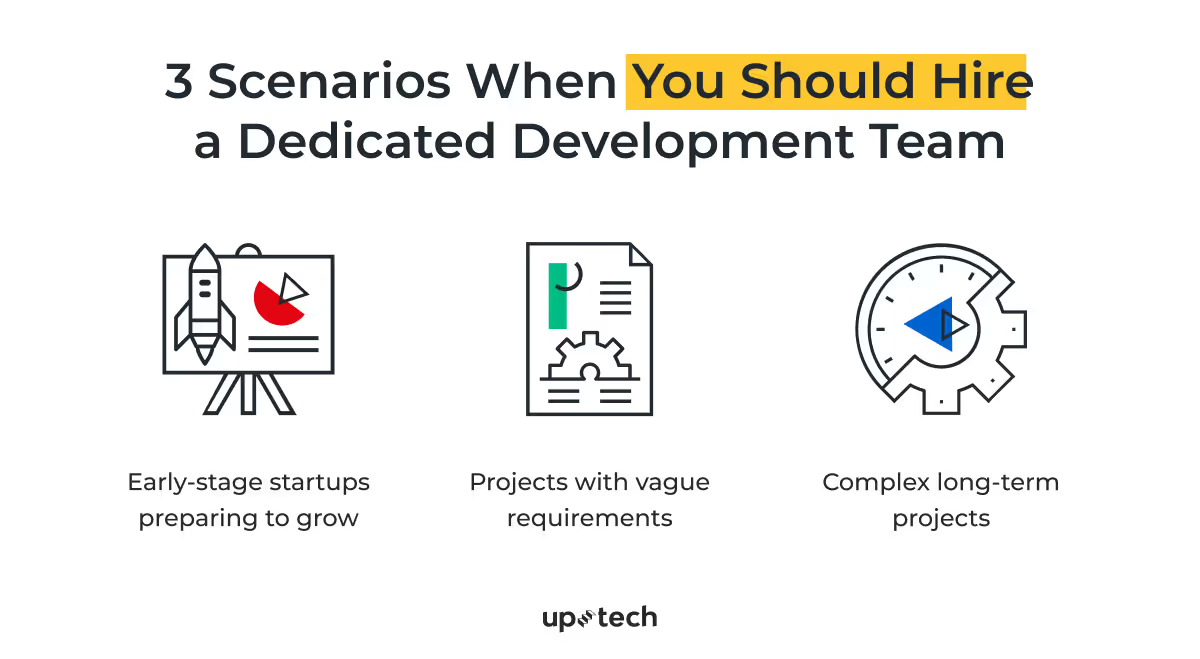
Early-stage startups preparing to grow
If you’re an early-stage startup and you’re expected to grow, consider the idea of hiring a dedicated development team. When you’re building your first version, validating your assumptions, or preparing for investor rounds, a dedicated team can dramatically shorten your time to market.
With a dedicated development team, you can:
- Build a team quickly without lengthy hiring cycles
- Save money on recruitment, onboarding, and in-house overhead
- Maintain speed while your internal team focuses on fundraising, operations, sales, or partnership development
- Add or remove roles as priorities change (design, backend, QA, ML, etc.)
While your internal team handles strategy, fundraising, partnerships, and marketing, the dedicated team pushes the product forward. This setup is how many startups get from idea → MVP → traction significantly faster.
Projects with vague requirements
When your idea doesn’t have the product-market fit and needs a discovery stage, the dedicated team is the way to go.
A dedicated team gives you:
- Time and space to refine requirements without overpaying
- The ability to pivot based on user insights
- Capacity for experimentation (MVP → iteration → refinement)
- Stable monthly cost regardless of how often priorities shift
Discovery often takes months. A dedicated team gives you time, continuity, and enough bandwidth to explore properly, without overspending on endless scope changes.
Complex long-term projects
The dedicated team model is suitable for complex long-term projects, which have the potential to expand. Products that carry long-term roadmaps: scaling platforms, SaaS apps, fintech/healthtech systems, and AI-driven tools benefit from team stability and deep product context.
With a dedicated team, you gain:
- Long-term knowledge retention
- Technical consistency across features
- Easier scaling up or down when the roadmap changes
- No hiring/firing risks when priorities shift
This is why many companies adopt the dedicated model once they pass the pre-seed/prototype stage and need predictable delivery from a stable team.
Need an app built? Here’s a quick guide on how to find app developers.
3 Cases When a Dedicated Development Team Might Not Be the Best Fit
Despite the obvious perks, the dedicated team model is not a one-size-fits-all approach. Here is a list of situations when, out of two choices to hire or not to hire a dedicated development team, I advise picking the latter.
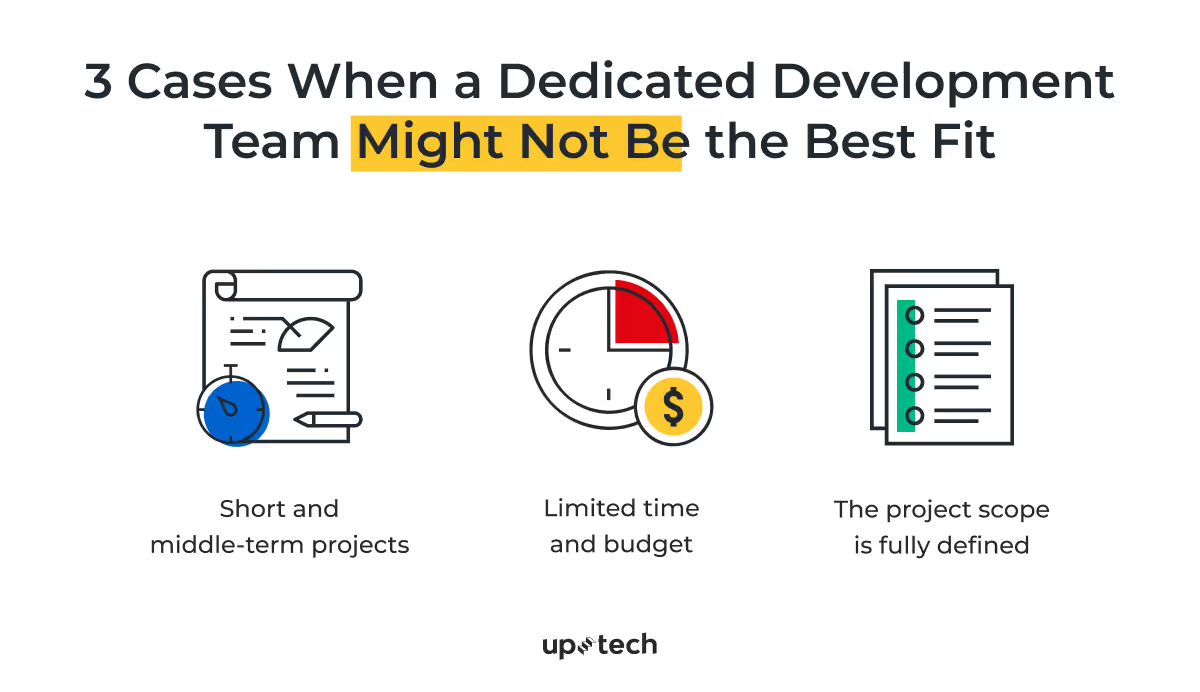
Short and medium-term projects
You don’t need to hire dedicated development teams for small projects with clear and defined requirements. When the work scope is strictly defined, you need a team to execute the assigned tasks.
In these cases:
- Fixed-price works best for short-term builds where every feature is known upfront.
- Time & Material fits mid-term projects where requirements may shift slightly, but you still don’t need long-term team continuity.
A dedicated team would be overkill — you’d pay for stability and availability you don’t truly need.
Limited time and budget
When your budget for a project is strictly fixed, opting for a dedicated team model is not the best idea. Sometimes you just don’t need a full-time designer or a project manager. In this situation:
- A fixed-price contract lets you cap spending.
- A hybrid or T&M model lets you use specialists only when you need them.
If you’re not planning continuous development, don’t lock yourself into a full dedicated team – it defeats the purpose.
The project scope is fully defined
The dedicated model shines when projects evolve, pivot, and scale.
But if your project has:
- a strict execution plan
- a fully defined feature list
- no expected discovery or experimentation
- little to no chance of pivoting
…then a dedicated team is unnecessary.
You’re paying for flexibility and long-term commitment, but you won’t be using either.
In such cases, a fixed-price or Time & Material model is more suitable and far more cost-efficient.
How Much Does Hiring Dedicated Development Team Cost?
Deloitte’s Global Outsourcing Survey reports that around 80% of executives plan to maintain or increase their investments in third-party outsourcing. Cost savings have always been one of the biggest arguments for outsourcing.
How the pricing works
The pricing structure for a dedicated team is deliberately simple:
- Each specialist has an hourly rate (developer, designer, QA, PM, BA, etc.)
- You pay only for the hours actually worked
- No hidden operational costs: no office rent, equipment, software licenses, employee taxes, onboarding overhead, or HR management expenses
In other words, the entire budget goes into actual development rather than supporting internal infrastructure. For many companies — especially startups and teams in high-cost regions — this alone can translate into substantial savings.
What influences the final cost
While the pricing model is straightforward, the final cost depends on several variables:
- Team composition (engineers only vs full cross-functional team)
- Seniority levels
- Region of the development partner (for example, Eastern Europe vs LATAM vs US)
- Project duration and workload
- Specialized expertise required (AI/ML, DevOps, cybersecurity, etc.)
But the bottom line remains the same: A dedicated development team gives you predictable monthly spending, no overhead, and significantly lower hiring and operational costs, while still giving you long-term continuity and focus.
Typical hourly rate ranges by region and role
Note: Based on our research and analysis of open market data, the average hourly rates generally fall within the ranges below. Actual pricing depends on the developer’s level, tech stack, and project specifics, so consider these numbers as indicative, not fixed.
Why is it cheaper than hiring in-house
Hiring a full in-house team involves slow and expensive processes: recruiting, screening, onboarding, trial periods, retention, benefits, equipment, and administrative overhead.
A dedicated team sidesteps all of this.
You get:
- Faster hiring (days or weeks vs months)
- Access to already-vetted specialists
- No recruitment costs
- No long-term employment commitments
- Flexibility to scale the team up or down
What influences the final cost
While the pricing model is straightforward, the final cost depends on several variables:
- Team composition (engineers only vs full cross-functional team)
- Seniority levels
- Region of the development partner (e.g., Eastern Europe vs LATAM vs US)
- Project duration and workload
- Specialized expertise required (AI/ML, DevOps, cybersecurity, etc.)
But the bottom line remains the same: A dedicated development team gives you predictable monthly spending, no overhead, and significantly lower hiring and operational costs — while still giving you long-term continuity and focus.
Why Uptech is a Good Choice While Hiring Dedicated Development Team?
At Uptech, we’ve spent the last 10 years helping startups and established companies build products that genuinely matter.
Over this decade, we’ve partnered with fast-growing e-commerce brands like Dollar Shave Club and GOAT, and long-term fintech clients such as Aspiration — where we’ve worked for years as an extension of their own team.
To date, we’ve delivered more than 200 products, maintaining an average client relationship of around five years.
This level of involvement is what we mean by dedication: treating the product as if it were our own, not just another item in the delivery queue. We help shape the product vision, not simply execute it.
In practice, this translates into consistent delivery, shared ownership, and a team that grows alongside the product. It’s especially valuable for companies entering new markets, scaling quickly, or navigating complex product lifecycles.
Uptech’s Process for Setting Up a Dedicated Development Team
Here's what happens when a client hires us as a dedicated development team:
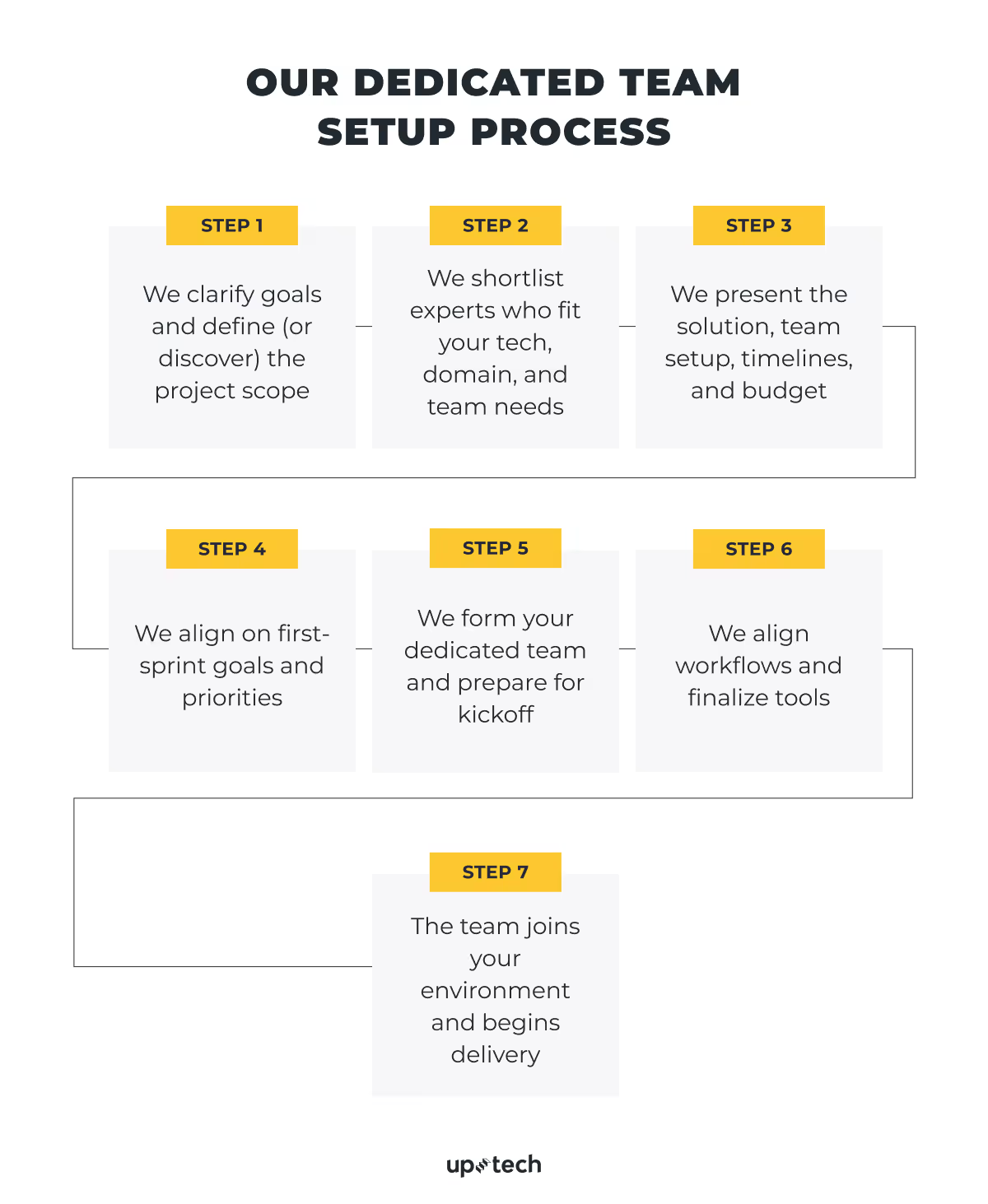
Requirements gathering and scope estimation
At this phase, we figure out how much work is expected to be done and how many people need to be involved.
For that, our team representative will contact you via a pre-planned call to understand your needs and preferences. Based on that information, we define the project's requirements and determine the project's scope.
There are two possible scenarios for the scope determination:
- You have a predefined scope. We'll discuss the budget with the client by considering the priorities and estimated or given timelines.
- You don't know the exact scope. We can carry out a discovery stage where we make hypotheses and test them with the help of prototypes.
Based on the test results, we assess whether the existing scope aligns with our vision. If not, we proceed with further discovery and research until we find the needed scope.
Talent selection
At this stage, after gathering all the needed inputs, we put together a team of skilled and motivated professionals to work on your project. Here are the criteria that we use for selection:
- Technical fit — experience with relevant tech stack, platforms, and architecture patterns
- Domain fit — prior work in your industry (healthcare, fintech, e-commerce, AI, etc.)
- Seniority mix — the right balance between efficiency, expertise, and cost
- Team dynamics — how well they collaborate, communicate, and make decisions
- Motivation and ownership mindset — people who treat your product as their own
The outcome for this stage is a stable, long-term team fully dedicated to your product roadmap.
Proposition call
At this stage, we present a suggested solution, expected team composition, timelines, budget, and plan additional research activities, if necessary.
This meeting will give you a clear picture of what the collaboration will look like.
Scope call
At this call, we discuss the purposes, milestones, and priorities for the first sprint with your dedicated team. The goal is to make sure both your team and ours understand what will be delivered first and why.
Team assembling
After final approvals, we officially assemble your dedicated team based on interview results, workload expectations and product roadmap priorities
For projects needing fast progress, we can form a core team immediately (developers, PM, QA, designers), with the option to scale later as the project grows.
Kick-off call
This is where collaboration formally begins. During the kick-off call, we:
- Introduce the Uptech dedicated team and your internal team involved
- Clarify the final version of responsibilities and workflows
- Align project goals and business priorities
- Finalize tools, communication channels, and access to them
- Set up sprint ceremonies and reporting structure
Team onboarding and start of work
The team joins your environment, receives access and context, and begins working on the aligned roadmap and initial sprint tasks.

Conclusion
In the end, the right development model shapes not only how you build, but how fast you can adapt. Dedicated teams outperform when learning cycles are ongoing, when priorities shift, and when momentum matters more than fixed delivery checklists. They give you the structural flexibility to grow with the market instead of chasing it.
Not sure which model works best for you? Contact us, and walk you through the options and help you make a decision rooted in your project’s long-term strategy.





























.avif)