It is always better to rely on real data instead of general assumptions. The healthcare industry is no exception. For a clearer view of what is actually happening in terms of AI adoption, where the technology is already in use, and where it still has limits, looking through AI in healthcare statistics is a good way to go.
Today, AI already supports a range of tasks. Medical device teams use it to keep products aligned with changing requirements. In drug research, it helps shorten early testing cycles. There are also more complex cases, such as digital models of the human body that assist doctors in cancer treatment decisions.
There is also a shift in day-to-day clinical work. Some routine processes no longer require manual effort, which gives clinicians more time to focus on patients.
I am Oleh Komenchuk, ML Department Lead at Uptech, a software development company. I work with product teams on AI solutions in healthcare and other industries. In this article, I collected key statistics about AI in healthcare to show how the market develops and what stands behind these changes.
Key AI in Healthcare Statistics in a Nutshell
Before we explore AI in healthcare statistics in more detail, it helps to understand how much the industry already spends, both globally and in the US.
Healthcare spending has been going up year by year across all major markets. In the US alone, it reached $4.8 trillion in 2023, or 17.6% of GDP. That’s the highest in the world. In comparison, countries like Germany, France, the UK, and Canada usually stay in the 9-12% range.
If you look at the global trend over the past decade, most countries in the dataset moved from around 6-9% of GDP to roughly 8-11%. So the direction is pretty clear: healthcare costs keep growing.
This is exactly why AI gets so much attention here. When spending keeps rising, there’s constant pressure to make things faster, cheaper, and more efficient.
AI adoption in healthcare
So, what is really happening in the industry? To answer that, I will show you some general healthcare AI adoption statistics.

In the US, actual usage at the company level is still relatively low. Based on Census Bureau data, AI adoption across healthcare firms averaged 5.9% between September 2023 and May 2025. Some segments move faster. Outpatient and ambulatory care increased from 4.6% in 2023 to 8.7% in 2025.
At the same time, broader industry surveys show a different picture. According to NVIDIA’s 2026 report, 70% of healthcare and life sciences organizations say they already use AI, up from 63% in 2024.
Hospitals also rely on AI in daily work. The Deloitte 2024 Health Care Outlook states that around 80% use it for patient care or workflow efficiency, which shows that AI is already part of real clinical settings.
The market numbers support this shift. The global AI healthcare market reached $32.34 billion in 2024 and is expected to grow to $431.05 billion by 2032.
Put together, these numbers show steady progress. Some areas still move slowly, but overall adoption continues to expand.
Adoption of generative AI in healthcare keeps growing. In NVIDIA’s survey, 69% of organizations reported using GenAI and LLMs in 2026, up from 54% in 2024.
This increase shows that GenAI has moved past early testing. Many teams now use it in real workflows, from clinical documentation to patient communication and internal decision support.
At the same time, broader interest is even higher. According to McKinsey, 85% of healthcare leaders are either exploring or already using GenAI.This gap between exploration and active use suggests that many organizations are still in the process of implementation or scaling.
Together, these numbers point to a clear shift. Generative AI is no longer a niche tool. It is becoming, slowly but still, part of everyday operations, even if adoption levels still vary across different types of healthcare organizations.
AI agents and emerging adoption
AI agents address a clear problem in healthcare. Doctors do not have enough time. On average, a physician spends about 15 minutes with a patient, then another 15 to 20 minutes on EHR updates. Administrative work often takes as much time as the visit itself.
AI agents help reduce this load. They automate EHR documentation, treatment coding, and routine coordination tasks. This frees up time for patient care and clinical decisions.

Adoption is still at an early stage, but it continues to grow. In NVIDIA’s survey, 47% of organizations said they use AI agents or assess their use cases. On a broader level, as McKinsey states, more than 80% of US healthcare organizations had some form of AI strategy in 2025. Many of these efforts focus on routine tasks.
The results show clear operational gains. In one rollout, AI agents led to a 30% drop in handling time, a 20% increase in first-call resolution, and a 15% rise in patient satisfaction. These improvements appear in areas with repetitive and time-sensitive processes.
There is also a strong financial impact. Administrative work makes up 15-30% of total healthcare costs. About 20% of these tasks can be automated with agentic AI. At scale, this leads to large savings. Estimates from the NBER cited in recent reports suggest a 5-10% reduction in US healthcare spending, or around $200-$360 billion each year.
AI in drug discovery and development
AI is changing how new drugs are discovered. It helps teams find promising biological targets earlier and improves lead optimization. This has a direct effect on how fast drugs move through the pipeline.
The market speaks louder than words. According to Grand View Research, AI in drug discovery was valued at $2.35 billion in 2025 and is expected to reach $13.77 billion by 2033, with a 24.8% annual growth rate between 2026 and 2033.
Adoption is already happening in real work. In an NVIDIA survey, 48% of companies in pharma and biotech said they use AI agents for drug discovery and biomarker identification. This means that AI has moved beyond early testing. Many scientists rely on it in day-to-day research.

Costs are also starting to shift. Early-stage drug discovery can cost millions of dollars, especially during target identification and screening. AI can reduce this part of the process to about $150,000, which makes it easier to test more ideas.
Timelines are getting shorter as well. Some AI-designed drug candidates reach clinical trials in less than a year. In earlier stages, AI can reduce discovery timelines from 4-6 years to around 18 months.
Research activity continues to grow. A large review that looked at more than 19,000 studies shows how widely AI is used in this field.
What Are the Most Widely Used AI Technologies in Healthcare?
The most widely used AI technologies in healthcare today are NLP, Computer Vision, and predictive analytics. At least, that’s what I have noticed. They show up most often in real clinical workflows, from documentation and imaging to early risk detection and decision support.
Natural Language Processing (NLP) in medical documentation
From what I’ve seen, natural language processing (NLP) is already widely used in day-to-day clinical work, especially when it comes to documentation.
A lot of clinics rely on NLP to handle routine tasks that used to take hours. For example, it can automatically transcribe patient visits, so doctors don’t have to write everything down manually. It also helps turn unstructured clinical notes into structured data that systems can actually use.
This matters more than it may seem at first. Most medical data still lives in free-text formats like doctor notes, pathology reports, or surgical summaries. NLP methods help extract key details from that text, such as diagnoses, procedures, or patient characteristics, and convert them into structured records.
In practice, this includes tasks like named entity recognition, where the system identifies things like medications or conditions, and text classification, which helps sort clinical events into categories. There are also simpler rule-based approaches that work well with semi-structured data, for example, in surgical registries. But what about this type of AI in healthcare stats?
A recent study published in the New England Journal of Medicine AI looked at how AI scribes affect real clinical workflows. The research included 238 physicians across 14 specialties and over 72,000 patient visits.
During a two-month period, some physicians used an AI scribe, while others continued with their usual documentation process. The tool recorded patient conversations and used speech recognition and NLP to generate draft clinical notes, which doctors then reviewed and edited.
Physicians who used the tool spent less time on documentation. On average, note-writing time dropped from 4 minutes 30 seconds to 3 minutes 49 seconds, which equals about a 10% reduction compared to the control group. The result was statistically significant.
The study also pointed to improvements in physician experience, including lower levels of work-related stress and burnout.
Computer vision in radiology
To be honest, computer vision is one of the few AI use cases in healthcare that already feels… normal. In many clinics, it’s part of the routine. It helps radiologists go through images faster and catch things that might be easy to miss.
At its core, it’s pretty straightforward. Models are trained to analyze X-rays, CT scans, and MRIs. They don’t replace doctors, but they do act like a second set of eyes. If something looks off, the system flags it, so the radiologist can take a closer look.
This is also where adoption is the highest. If you look at recent statistics on AI in healthcare, radiology clearly leads. Around 90% of organizations already use AI here in some form, even if it’s not fully rolled out.
What’s interesting is that it’s not just about usage. Accuracy has improved, too. Some studies show that models can match or even outperform radiologists in tasks like chest X-ray analysis or cancer detection. In one review, multimodal AI models reached 95.6% accuracy, with sensitivity of 94.2% and specificity of 92.1%. At the same time, overall error rates dropped to about 8%.
You can also see the impact in day-to-day work. Tasks that used to take a few minutes now take seconds. For example, analyzing pulmonary nodules went from almost 3 minutes to under 40 seconds, without a drop in quality. In some cases, models even found more nodules than radiologists did.
There are also small but meaningful gains in productivity. With AI support, efficiency increased from 65.1% to 70.3% in some studies. It doesn’t sound huge, but when you scale it across teams and workloads, it adds up quickly.
Predictive analytics in healthcare operations
In practice, predictive analytics is used less on the clinical side and more behind the scenes. It helps hospitals manage workloads, plan schedules, and make day-to-day operations a bit more predictable.
A common example is workload forecasting. Hospitals use historical data to estimate how many patients they will have and when. This helps avoid overload during peak hours and underutilization during quieter periods. The same goes for scheduling. AI models can suggest better shift distribution for doctors and staff, based on expected demand.
It may sound like a small improvement, but it adds up. When schedules make more sense, teams work more efficiently, and patients spend less time waiting.
On the clinical side, predictive analytics also supports early risk detection. Models trained on EHRs, claims, and imaging data can estimate the likelihood of readmissions or disease progression. In some cases, Random Forest models reached around 89% accuracy in disease risk prediction.
There are also strong results in more specific tasks. AI systems showed over 91% accuracy in predicting hospital readmissions using hundreds of variables, while reducing false positives by 42%. In primary care, predictive models improved early detection of conditions like diabetes and cardiovascular disease by up to 48%.
These results align with broader AI in healthcare statistics, where predictive analytics continues to show strong performance in both operational and clinical scenarios.
Another interesting point is cost. Some models that track chronic disease progression reached 87.3% accuracy and helped reduce diagnostic costs by over 30%. When risks are identified earlier, it becomes easier to prevent complications instead of reacting to them later.
What AI Technologies Have High Potential?
The short answer: multimodal AI, federated learning, and generative AI for synthetic data. Recent healthcare AI adoption statistics (including those from 2026) highlight growing interest in these approaches, especially for secure data use and cross-system integration.
Multimodal AI systems
While not the most widely used approach yet, multimodal AI has strong potential. The idea is simple. Instead of working with one type of data, the model combines several sources at once. This can include medical images, lab results, clinical notes, or even genomic data. When all of this sits in one system, it becomes easier to support clinical decisions.
In practice, this means a model can look at a scan, read a doctor’s notes, and take lab values into account at the same time. This gives a more complete view of the patient compared to traditional single-input models.
Research in this area has grown quickly. A scoping review shows that publications on multimodal AI in medicine increased from just 3 papers in 2018 to 150 in 2024, based on 432 studies across different specialties.
There are already performance gains, too. Across multiple studies, multimodal models improved average AUC by 6.2 percentage points compared to unimodal approaches. Most systems rely on intermediate fusion, which appears in about 79% of cases, while late fusion is used less often, around 14%, mainly when data sources are not perfectly aligned.
There are already clear use cases. Researchers apply multimodal models to problems like
- Alzheimer’s diagnosis, where MRI data is combined with clinical or genomic information.
- Lung cancer risk assessment, where CT scans are used alongside patient records.
What about the market? Multimodal AI in healthcare was estimated at around $1.2 billion in 2023 and is expected to grow at a 30%+ annual rate through 2032.
At the same time, adoption is not simple. Healthcare data is often scattered across disconnected systems, comes in different formats, and is not always complete. Missing data remains a common issue, so teams rely on techniques like data imputation or adjust model design to handle gaps.
Federated learning in healthcare
Federated learning is a different way to train AI models in healthcare. It’s when we don’t collect data from multiple hospitals in one place, but each hospital keeps its data on its own servers. The model trains locally, and only the updates are shared. Patient data never leaves the institution.
This matters because data privacy is a constant constraint in healthcare. Regulations like HIPAA and GDPR limit how data can be shared. Federated learning gives teams a way to work together without breaking these rules.
Research in this area has picked up in recent years. Studies from 2023 to 2025 show that federated learning is more actively used in medical imaging, public health, and mortality prediction. As of 2023, searches for federated learning in healthcare returned 90 results on PubMed, 25 on arXiv, and 192 on IEEE Xplore. Medical imaging is one of the main areas of focus.
In terms of performance, it holds up well. A meta-analysis that covered 9 studies and more than 1.4 million patients reported an AUC of 0.81 for federated models, compared to 0.82 for centralized machine learning. The gap is small, which shows that keeping data local does not hurt results in a meaningful way.
AUC stands for Area Under the Curve. In simple terms, it shows how well a model can tell the difference between correct and incorrect outcomes. An AUC of 1.0 means perfect predictions. An AUC of 0.5 means the model performs no better than random guessing. So values around 0.8 indicate strong performance.
There are also practical examples. In mammogram analysis, federated models performed better than models trained on data from a single institution. They handled new data more reliably across different sources.
Federated learning already appears in real use cases. It has been applied to cancer diagnosis, COVID-19 detection, diabetic retinopathy, tuberculosis screening, and mental health studies. Many of these projects involve multiple institutions that cannot share raw data.
There are still challenges. Data can look very different from one hospital to another. Some systems lack the infrastructure to support this approach. Reviews of more than 200 studies also point to issues with fairness and consistency. In mortality prediction, researchers report high variability between results and a noticeable risk of bias.
Federated learning does not solve everything, but it offers a practical way to work with distributed healthcare data. It makes collaboration possible in cases where data sharing is not an option.
Generative AI for synthetic data
In my opinion, generative AI, specifically for creating synthetic data, is another area still finding its place in healthcare. In medicine, getting access to real data is often difficult. Privacy rules are strict, datasets are small, and rare conditions make things even harder. Synthetic data helps work around these limits.
In simple terms, generative AI can create artificial data that looks like real patient records, medical images, or signals. Teams can use this data to train models, test ideas, or simulate research scenarios without exposing sensitive information. It also helps reduce bias and makes it easier to stay within GDPR and HIPAA requirements.

ML engineers use different models depending on the type of data. GANs are common for time-series data like physiological signals. Large language models are widely used for medical text. VAEs appear less often and mostly support longitudinal data. As for diffusion models, they are applied in more complex, multi-modal tasks.
There are already practical examples. In one case, models trained with synthetic brain MRI data reached 85.9% accuracy. In another, synthetic datasets were used to simulate clinical trials, including survival curves for acute myeloid leukemia.
Synthetic data is especially useful for rare diseases, where real-world data is limited. Researchers use it for conditions like
- sickle cell disease
- cystic fibrosis
- Duchenne muscular dystrophy
It also shows results in imaging tasks. For example, GAN-based models reached around 85% accuracy in detecting age-related macular degeneration.
A lot of current work still focuses on privacy. In studies that deal with longitudinal data, 16 out of 17 focus on privacy-related use cases, including kidney disease, Parkinson’s, diabetes, and hearing loss.
Overall, synthetic data helps solve a very practical problem. It gives teams more data to work with when real data is limited or hard to share.
Challenges of AI Adoption in Healthcare
AI in healthcare looks promising on paper, but real-world implementation is more complex. Teams face a mix of technical, regulatory, and operational challenges along the way. I will explain the three main challenges in more detail here and back it up with relevant artificial intelligence in healthcare statistics.
Regulatory and compliance requirements
From my experience, regulation is one of the main things that slows AI projects down in healthcare. Not because ML developers and healthcare providers don’t know what to do, but because the rules are different depending on where you launch. There is no shared global approach to AI approval.
In the US, the FDA treats AI systems as Software as a Medical Device (SaMD). That gives teams some room to work with, especially when it comes to updates. In the EU, things feel heavier. Under MDR and IVDR, you need solid clinical evidence from the start, and you have to keep monitoring the system after it goes live.
Then there is the data side of things. GDPR in Europe, HIPAA in the US, and China’s PIPL. Each one sets its own rules for how patient data should be handled. In practice, this means you cannot just build once and launch everywhere. You end up adjusting the same product again and again to meet local requirements.
For more information on these regulations and what aspects to pay attention to early on, read our guide on GDPR and HIPAA compliance.
Some of the existing approval paths also don’t quite fit AI. For example, the FDA’s 510(k) process relies on comparing a new product to something that already exists. That works fine for traditional devices, but it gets tricky with AI models that evolve over time. Cases like IDx-DR made that pretty clear.
At the same time, approvals are growing fast. By the end of 2025, the FDA had cleared more than 1,300 AI and ML-based medical devices, and almost 80% of them were in radiology. In 2025 alone, there were 295 approvals, which is noticeably more than in previous years.
But even with that progress, a lot of gray areas remain. One that comes up often in conversations is responsibility. If something goes wrong, who is actually accountable? The developer, the provider, or the doctor who used the system? There is no single answer yet.
Trust and explainability
One of the biggest barriers to AI adoption in healthcare is the trust issue. Both clinicians and patients hesitate to rely on systems they don’t fully understand.
For doctors, the problem often comes down to explainability. If an AI system shows how it reached a decision, trust increases. Studies show that when explanations are clear and reliable, clinicians' trust scores rise by 12-18 percentage points. When AI outputs are transparent and confident, doctors are also less likely to ignore them.

In one study, override rates dropped to 1.7% with high-confidence predictions, compared to 73.9% when the system provided little explanation.
A meta-analysis of 90 studies found a positive link between explainability and trust. In simple terms, the more understandable the system is, the more likely clinicians are to use it.
To improve transparency, ML teams (ours is no exception) use tools like SHAP, Grad-CAM, and LIME, among others. These methods help show which factors influenced a prediction. In practice, they make AI outputs easier to interpret. Reviews of clinical decision support systems show that models can still perform well with these methods, with a median AUC around 0.87, while giving more insight into how decisions are made.
Even with these improvements, trade-offs remain. Some systems that include explainability features reach very high accuracy, up to 99.2%, but trust still depends on how clearly results are presented. When systems appear opaque or biased, doctors are much more likely to question or ignore them.
Now let’s also talk about patient trust. I went through a lot of surveys, and they show mixed and often cautious attitudes toward AI in healthcare.
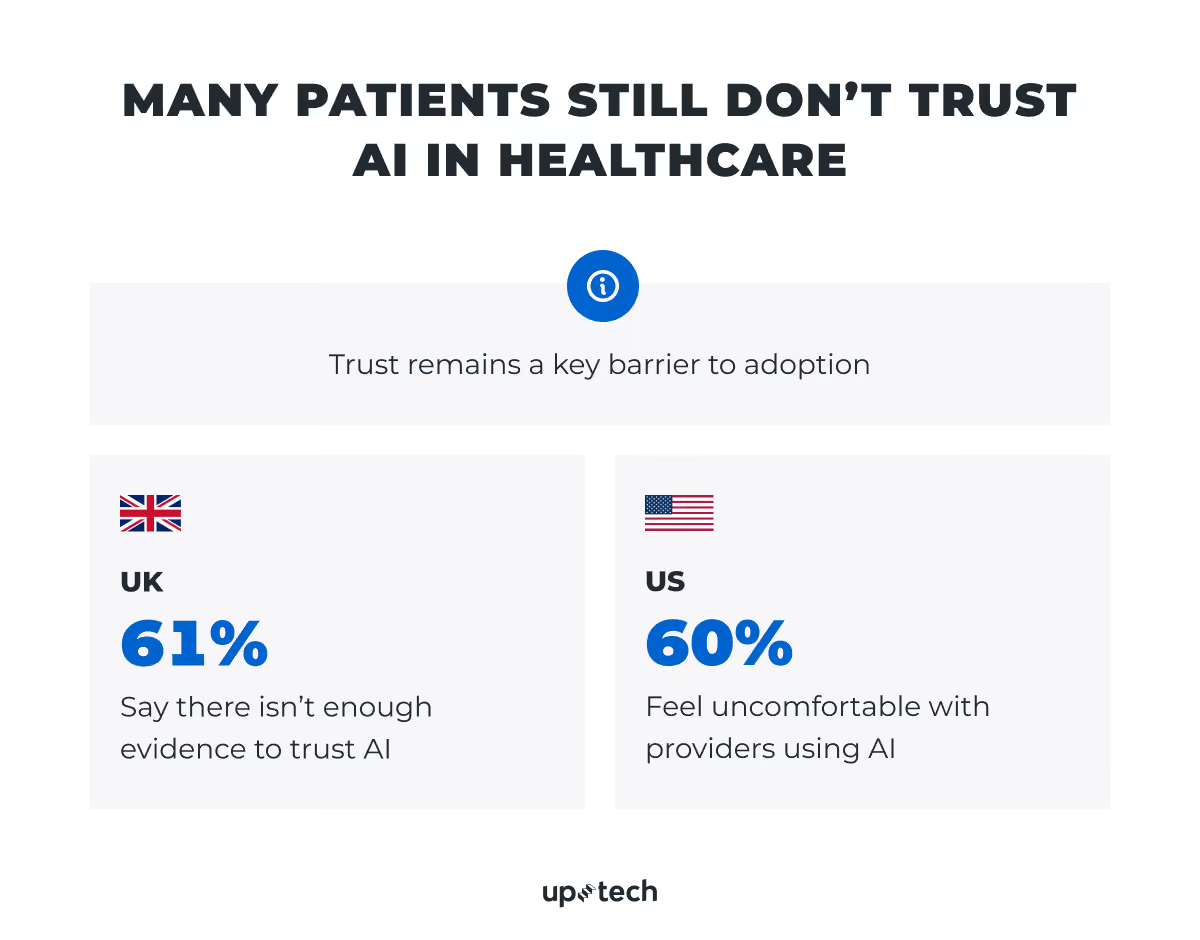
- In the UK, for example, 61% of respondents in 2025 said there is not enough evidence to trust AI in healthcare.
- In the US, 60% of people reported discomfort with those providers who rely on AI.
At the same time, people who already trust the healthcare system tend to feel more confident about AI as well.
Exposure to tools like ChatGPT has increased familiarity, but it has not fully changed attitudes. Many patients still expect human oversight and worry about losing direct contact with doctors.
The main concerns are consistent. People worry about systems that act like a “black box,” potential bias, and errors in medical records.
Data limitations and legacy systems
From what I’ve seen, data is where many healthcare AI projects start to slow down. There’s little data, and it is often incomplete, messy, or hard to use across systems.
A common issue is simple scarcity. In some areas, especially rare diseases or less studied conditions, there just isn’t enough labeled data to train reliable models. Reviews show that around 40-50% of AI projects in healthcare face delays or fail because of this. It becomes even more obvious when you look at global trends.
Between 2010 and 2023, China ran over 1,000 AI-related clinical trials, the US had under 200, and resource-limited regions had only a handful. Many of those studies included fewer than 500 participants, which limits how useful the data is.
Even when data exists, quality is a huge problem. Different hospitals collect and store information in different ways. EHR systems rarely align. You end up with missing fields, inconsistent formats, and metadata that does not match across sources. In practice, this makes it hard for models to generalize beyond the environment they were trained in.
I’ve also seen how legacy systems make things worse. Older infrastructure was not built with AI in mind. Data gets stored in silos, and pulling together a full patient history can be surprisingly difficult. Sometimes records are incomplete simply because workflows interrupt data collection. That lack of continuity affects both training and real-world performance.
On top of that, there are concerns around privacy and ownership. Even anonymized datasets can carry re-identification risks. It is not always clear who owns the data, whether it is the hospital, the government, or the patient. Because of this, many organizations are cautious about sharing data, which limits the ability to train better models.
Artificial Intelligence in Healthcare Statistics: Our Experience
When you look at AI in healthcare statistics, many of them sound promising. But they start to feel more real when you see how this works in actual products.
For example, in our medical document processing project, we worked with a private diagnostic clinic that handled a large volume of patient documents every day. Most of these documents had to be reviewed, sorted, and entered into the system manually, which slowed things down and created room for errors.
We introduced an AI-driven workflow that combined OCR, NLP, and classification models. Instead of reading each document line by line, the system could scan it, extract key information, and structure it in a way the system could use. This included things like identifying document types, pulling out relevant patient data, and flagging inconsistencies.
Automation apart, the biggest difference was in how it fit into the existing workflow. The team no longer had to spend time on repetitive tasks like manual data entry or searching for specific records. Instead, they could focus on reviewing and validating the output.
As a result, document processing time dropped by 34%, and the overall workflow became noticeably smoother. The clinic was able to handle more patients without adding extra operational load, which also had a positive impact on service quality.

In another case, in the pharmaceutical space, we worked on a prescription automation solution that combined OCR and automated data entry. Before that, pharmacists spent around 5 minutes per document, manually entering data into the system. After implementation, the process took about 30 seconds for AI processing and another 30 seconds for quick manual review. In practice, this reduced the time spent on each document by up to 90%.
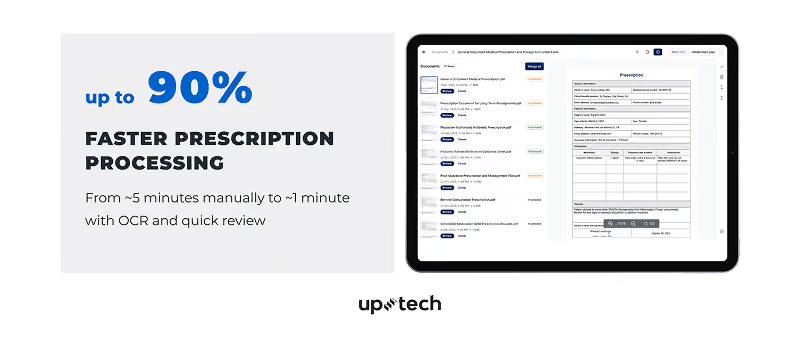
These are the kinds of results often reflected in broader artificial intelligence in healthcare statistics. Most of the value comes from saving time on repetitive tasks, reducing manual work, and making existing processes more manageable.
If you want to explore how similar AI solutions could work for your product, contact us to discuss your case.