For many years, IT outsourcing has been a popular option among technology companies. According to Deloitte’s Survey, 80% of executives are planning to maintain or increase investment in third-party outsourcing.
Besides multiple successful cases of outsourcing by big companies, many startups are still wary of outsourcing web development overseas due to trust and delivery concerns. However, the practice of big players shows that the reality of outsourcing is wholly different.
In this article, I want to use successful outsourcing cases from big companies to dispel misconceptions and draw lessons cofounders can follow.
Let us start!

Slack: Outsourcing is a Choice of Early-Stage Startups
Slack is a real-time office collaboration tool featuring chat rooms (channels) by topic, private groups, and direct messaging. Needless to say, now this is one of the most popular tools for business communication, with nearly 42 million daily active users.
From its earliest days, Slack invested in design and app development services: the company brought in MetaLab to create the UI/UX, branding, and mobile/web presence of the product, working from prototype onward.
Slack outsourcing case: Lessons learnt
Slack’s story shows how strategic outsourcing can accelerate product-market fit. This approach helped Slack launch a refined product quickly, attract investors, and onboard tens of thousands of users within weeks. The takeaway: outsourcing is a way to scale smarter and reach the market faster.

WhatsApp: Find the Expertise You Lack
Whatsapp is an app that hardly needs a presentation. Hands down, this is probably the most popular messaging app, with over 2 billion users around the globe. However, the wind has not always blown to WhatsApp founders’ backs.
Back in 2012, at the outset of WhatsApp’s story, it was a small organization with only 30 full-time employees and five part-timers. The company started only with $250,000 capital raised at the seed round.
Frankly saying, this is little to kickstart a product. But WhatsApp needed to keep its costs down and find the web development talents with the quality/price balance. This is why the company turned to East Europe, the biggest outsourcing hub, to find tech talents for developments.
WhatsApp outsourcing case: Lesson learnt
Outsourcing development can be a strategic way to extend your technical capability when you’re resource-constrained, provided you maintain internal focus on vision, product-market fit, and operational excellence.
CitiGroup: Outsourcing Helps to Save Up
Citigroup is one of the world’s biggest banks. By the early 2000s, it was running thousands of systems across dozens of countries. Keeping all that technology up to date costs a fortune. Every new tool or regulation meant more developers, more hardware, and more maintenance.
To stay competitive, Citi decided to outsource a big part of its IT work. Instead of hiring thousands of full-time engineers, the company started working with large tech vendors that helped with software updates, testing, support, and data processing.
The impact was huge. Citi gained access to skilled engineers in countries like India and Poland, where development ran 24/7. Projects finished faster, and costs went down. The internal teams could now focus on improving products, customer experience, and security.
Outsourcing tech development is a widespread example among banking giants. For example, banking entities such as Bank of America, Barclays, Goldman Sachs, and J.P. Morgan also hire developers overseas.
Over time, outsourcing became part of Citi’s DNA. But by 2025, the leadership noticed something new: they had become too dependent on external teams. Control and communication were harder to manage, and some critical IT knowledge had drifted outside the company. So Citi made another big move — it began cutting back on contractors and hiring its own engineers again.
CityGroup outsourcing case: Lesson learnt
Over the years, Citigroup learned that outsourcing can bring real advantages like faster delivery, lower operational costs, and access to global talent. However, it also discovered the importance of balance. When too much knowledge and control move outside the company, it becomes harder to manage quality and security. The key lesson: outsourcing works best when it supports your business goals, not replaces your core expertise.

Basecamp: Outsource Web Development and Focus on Business
Basecamp started life (under the name 37signals) as a web-design/consultancy firm, and gradually shifted into making its own flagship product: the project-management tool “Basecamp.” As the business grew, the team discovered a paradox: they were building a tool for managing projects, but internally they weren’t always managing their own workflow and developer capacity in the most efficient way. This is the classic example of the “cobbler’s children” problem.
Recognizing that internal bottlenecks (in development of new features, app/mobile versions, and client support) were distracting them from their core product growth, Basecamp opted for a strategic outsourcing move: rather than trying to staff up dramatically in-house and stretch existing teams, they engaged external/remote developers to take over certain “essential development functions”.
By outsourcing parts of the software development (especially when remote developers could handle modules, enhancements, or parallel tracks), Basecamp freed its internal team to focus on business priorities: refining core product direction, focusing on customer support and product-market fit, and internal process improvements rather than just “keeping the lights on”.
Basecamp outsourcing case: Lesson learnt:
If your organization is strong on product vision but weak in managing internal support, maintenance, or parallel development paths, outsourcing targeted development functions can be a way to refocus the core team on growth-oriented work.

Google: Outsource to Cut Labor Expenses
It turns out even the 89,000+ in-house Google army cannot handle the massive workloads. This is why Google outsources global talents and partners with contractors for its AdWords project, which completes the company’s lion’s share in revenue (2017). According to Bloomberg, 2018 was the first year when the number of Google’s contractors surpassed direct employees.
The move is explained in part by the need for flexibility, global skill access, and rapid scaling — especially in advertising, content moderation, cloud services, and other high-throughput functions. At the same time, such a model allows Google to operate with less fixed employment overhead and to tap talent from around the world.
Google outsourcing case: Lessons learnt
Outsourcing is a strategy for flexibility and global reach. When workloads surge or niche expertise is required, external teams can fill the gap faster and more efficiently than traditional hiring. This allows companies to keep core teams focused on innovation while outsourcing repetitive or specialized tasks to trusted partners.
Alibaba: Outsource the Talents You Need
Alibaba, the Asian e-commerce giant, is another example of successful outsourcing. As of now, the company wields 779 million active customers and has 149,2 billion in revenue. In fact, the company has outsourced its website design and development work.
Back in the 90s Jack Ma, Alibaba’s founder faced a scarcity of resources. There were Chinese specialists with expertise in e-commerce development. Another complication was that China had formidable internet restrictions, which was a hindrance for website development.
So the company started to seek partners and outsourced overseas across a range of different projects, and they found the human resources they needed in the US. By hiring specialists overseas, the website started growing at an astronomical pace. For instance, in 2014, Alibaba hit a record by becoming the largest IPO in history and raising $25B. Two decades later, it remains one of the world’s largest e-commerce ecosystems, with millions of active customers and annual revenues exceeding $137 billion as of 2025.
Alibaba outsourcing case: Lesson learnt
You should clearly see your weaknesses. By knowing the talent gaps in the region, Alibaba managed to outsource resources elsewhere and grow into a flourishing business.
Recap: Why Companies Outsource?
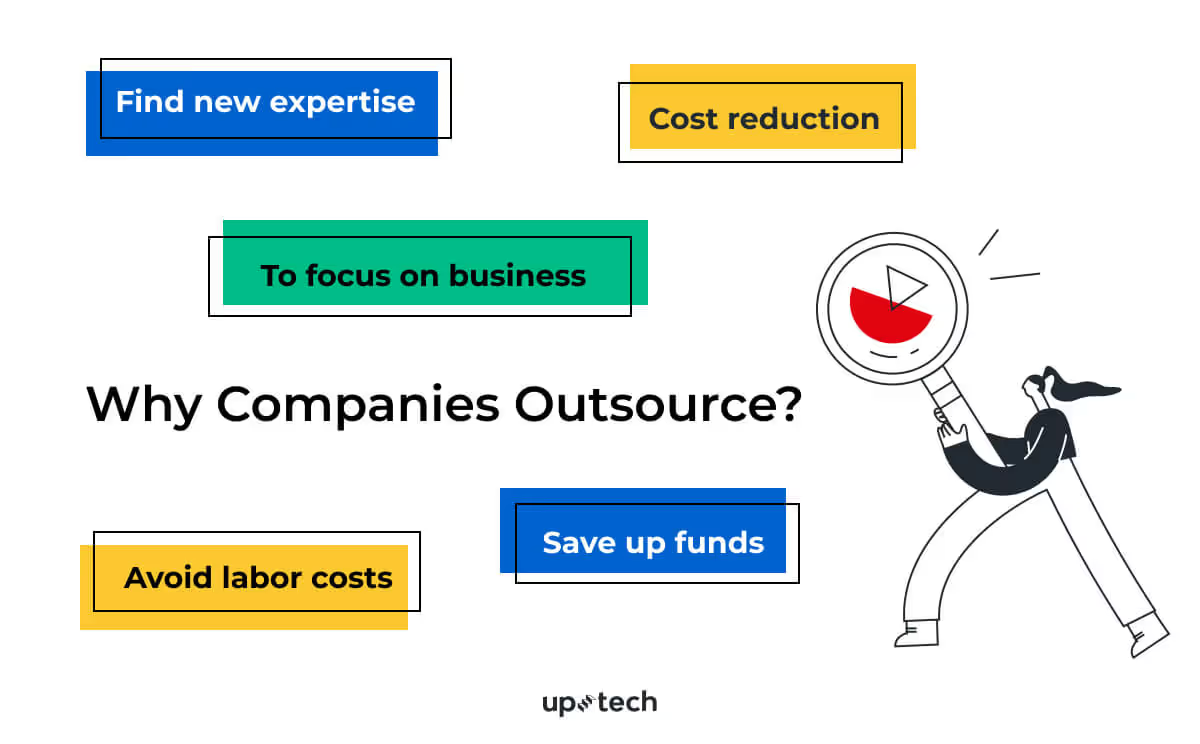
As it stems from the IT outsourcing examples, hiring developers remotely helps tackle many business problems. Let’s summarise some of them. Here are the key objectives that companies pursue when outsourcing developers from abroad:
Cost reduction
Reducing operational expenses remains one of the primary drivers behind outsourcing. By partnering with offshore or nearshore teams, companies can significantly cut costs related to office space, hardware, salaries, and benefits, especially in high-cost regions like the US or Western Europe.
Outsourcing also turns fixed costs into variable ones: instead of committing to long-term employment contracts, businesses can pay only for the specific expertise or hours they actually need. This flexibility proved essential during economic downturns and periods of uncertainty.
Focusing on business priorities
Outsourcing allows leadership teams to redirect their attention and internal resources toward strategic goals. When technical tasks are handled externally, companies can double down on areas like product vision, customer acquisition, and market expansion.
This focus often translates into faster decision-making and improved product-market fit. Instead of managing developer workloads, the company’s core team can spend time refining value propositions, improving operations, or pursuing partnerships — areas that directly impact growth and competitiveness.
Saving funds at the early stage
For startups, outsourcing is often a survival strategy. In the early stages, every dollar counts, and hiring a full in-house development team can quickly exhaust limited capital.
By outsourcing development to reliable external partners, founders can launch a minimum viable product (MVP), test user demand, and validate their business model all before committing to a larger team. This approach reduces financial risk and ensures that investments go where they matter most: building traction and proving the concept.
Gaining access to new expertise
Innovation moves fast, and not every company has the in-house skills to keep up. Whether it’s integrating AI features, experimenting with augmented reality, or implementing blockchain technology, recruiting specialized experts full-time is expensive and time-consuming.
Outsourcing provides immediate access to skilled professionals with niche expertise. Businesses can bring in these specialists for a limited time, complete the project efficiently, and scale down once the task is done. This model keeps the organization agile while allowing it to explore new technologies and stay ahead of competitors.
Avoiding extra labor costs
Hiring employees comes with hidden expenses: recruitment, onboarding, training, benefits, insurance, and compliance. By outsourcing, companies can bypass much of this overhead. Contractors and service providers handle their own infrastructure, taxes, and management, allowing the client company to maintain leaner operations.
This model lowers administrative complexity. For large corporations, outsourcing repetitive or non-core functions (like QA, maintenance, or customer support) can translate into millions in annual savings and faster project delivery across time zones.

Conclusion
The IT outsourcing cases above prove that outsourcing is a strategic growth tool for businesses of all sizes. When done right, outsourcing helps companies cut operational costs, access rare expertise, and stay focused on what truly drives results. From startups building their first MVP to global enterprises scaling their platforms, the benefits remain consistent: flexibility, speed, and smarter resource allocation.
At Uptech, we’ve helped dozens of companies apply this approach effectively — from validating early-stage ideas to expanding long-term digital ecosystems. Our experience shows that success in outsourcing comes down to partnership: clear communication, shared goals, and trust.
If you’re exploring how outsourcing could strengthen your business, our team can help you find the right balance between cost, quality, and speed.
Contact us for a free consultation.





























.avif)